436 Ion Operations Manual
Standard - After five seconds of no response from the master, the backup will assume the mas-
ter has disconnected and will then take control.
Engineered - After 1.6 seconds of no response from the master, the backup will assume the
master has disconnected and will then take control.
Change IP Address
Each Eos device on the network should be given a unique IP address. If running multiple devices of
the same type (for example - two consoles, or two RPUs), you must alter the default static IP
addresses to ensure proper functionality. For a list of the default IPaddresses for Eos devices, see IP
Address (on page454)
Changing the static IP address is done through the ECU (see Network Settings (on page453)). Manu-
ally change the IP address of any non-master Eos device by clicking in the IP Address field and enter-
ing the new number from the keyboard. When done, press [Enter].
Note: It is recommended that you alter the very last digit of the static IP address by an incre-
ment of one for each additional Eos device on the network. Therefore, if the master ends in
“101”, change the backup to end is “102”, a client to end in “103” and so on.
Output in Client Mode
Consoles in client or backup mode by default will not output on their local DMX ports. This option is
found in ECU>Settings>Local I/O>Local DMXOptions or Setup>System>Output>Local
DMXOptions. Click on {Output in Client mode} to enable the ability to output.
Multiple Users
Ion can be set to act as a separate user from other consoles in the system, or it can be set to act as
the same user as another console. This is done by changing the user ID.
About User ID
When multiple users are on the Eos Family network, they can all act as one combined user, as all sep-
arate users, or any of the varying degrees between.
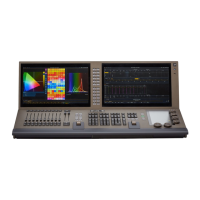
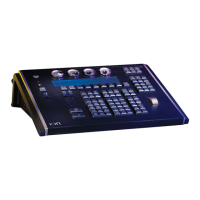
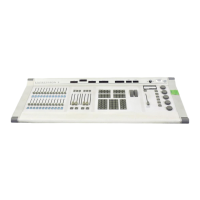
Any Eos, Eos Ti, Gio, Gio @ 5, Ion Xe, and Ion console, RPU,RVI, ETCnomad, and ETCnomad Puck can
be a separate user on the Eos Family network. Certain devices work well as independent users while
others are intended to share a user ID with another device. For example, consoles and RPUs are likely
candidates for working with a unique user ID while RVIs and client PCs can be useful sharing an ID
with another device to track programming information from a second location.
Set in the Setup (see Users (on page143)), User ID is an Eos-specific identifier that can be set
uniquely for each Eos device or can be shared between multiple devices allowing for shared data
between consoles. The user ID can be set anywhere from 1 to 99.
The decision to share a user ID is based on the desire to share a common workspace and command
line. It is often common for a designer to be the same user as a programmer so his displays and oper-
ating modes follow a programmer and his command line mimics the programmers. Alternatively, mir-
ror mode of a user can be called. It is also possible to set the designer up as a completely separate
user, adding a command line object to a magic sheet to allow a view into programming activities.



 To Next Page