XRF6 RF Router Manual
Page 2-4 Revision 1.0 INSTALLATION
CAUTION - TO REDUCE THE RISK OF ELECTRIC SHOCK, GROUNDING OF THE
GROUND PIN OF THE MAINS PLUG MUST BE MAINTAINED
2.4.2. Turning the Power On and Off
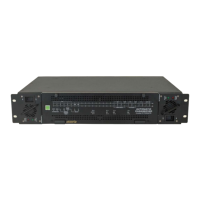
Each power supply is fitted with its own power switch. When the switch is turned off, the remaining power
supply will power the frame. To completely remove power from the frame, both power supplies must be
turned off.
2.4.3. Power Supply Indicator
Each power supply has two indicators. The LED on the left indicates the health of the entire frame. The
LED on the right indicates the health of the local power supply.
For example, if one of the power supplies malfunctions, then its local power supply LED will go off, and the
frame status LED on both power supplies will turn off. The local power supply status LED on the power
supply that is still functioning will remain on.
If there is a fuse failure return the power supply immediately. The power supplies are short circuit
protected and should not blow the fuse under a short circuit condition.
2.5. CONTROL AND COMMUNICATIONS
The XRF6 router can be controlled from third party monitor and control systems over the RS232 control
port, by the X-NCP2 remote control panel over Ethernet, or by Evertz VistaLINK
®
or other SNMP control
over Ethernet. The serial port pinouts are shown in section 2.5.1, and the protocol supported by the serial
port is documented in section 2.5.1 of this manual.
The Ethernet connection information is shown in section 2.5.2. Basic Operation of the X-NCP2 control
panel is documented in section 6.1. VistaLINK
®
control is documents in section 6.2. To interface with the
XRF6 router via third party SNMP managers, contact Evertz technical assistance for the required SNMP
MIB (management information database) information.
2.5.1. Serial Port Control Connection
This 9 pin female D connector provides an RS-232/RS-422 serial interface used for external serial remote
control. The Setup menu is used to configure the serial port for external control. See Table 2-1 and Table
2-2 for the pinout of the connector for RS-232 and RS-422 applications.



 To Next Page