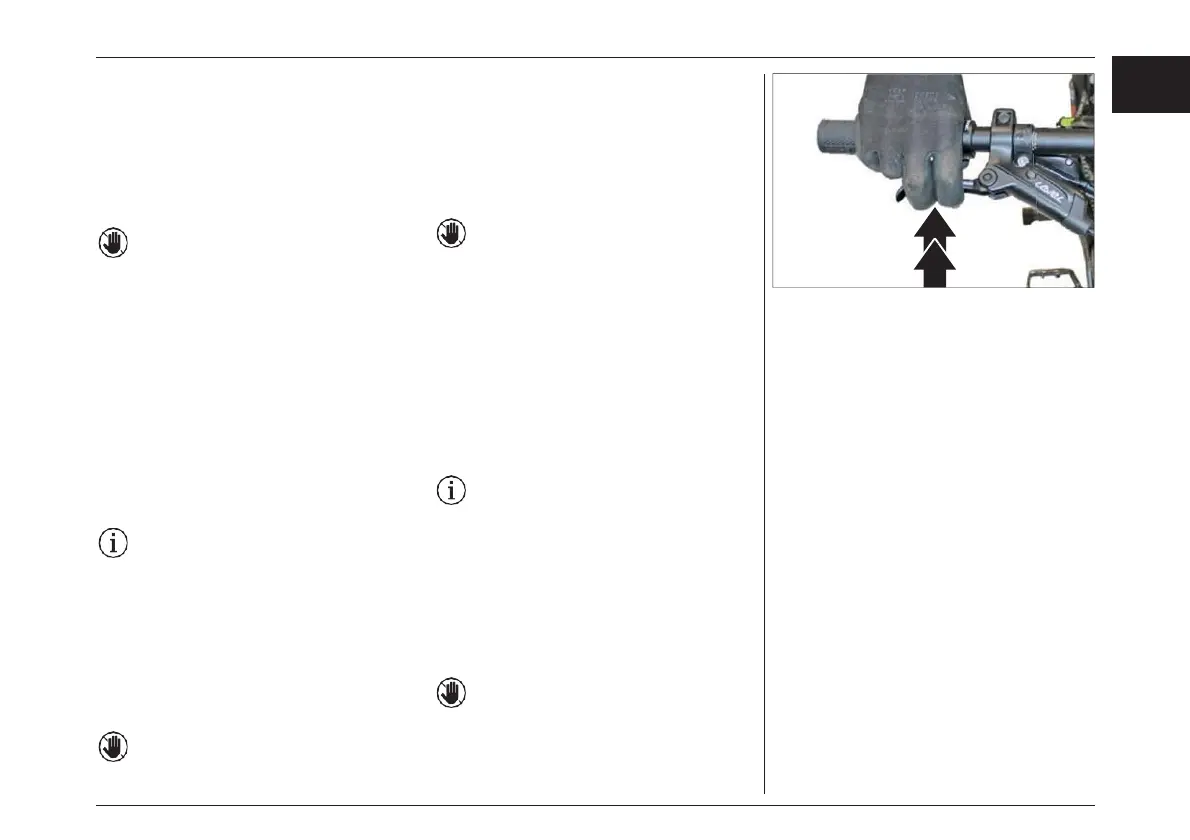
USE OF BRAKES
To activate a brake pull the respective lever in the
direction of the handlebar.
The maximum braking performance is achieved
by simultaneously operating the two levers.
65% (approximately) of the total braking force is
obtained from the front brake.
Danger of falls and accidents. Applying
the brake too hard can cause the wheels to
block and cause slippage or overturning.
It is necessary to become familiar with
the brakes operation. Begin by pedalling
slowly and applying the brake levers
with moderation. Perform these braking
exercises on flat road surfaces with low
traffic. Measure the brakes and apply the
two levers simultaneously. Be careful
when applying the front brake lever;
the presence of sand, gravel, etc. could
make the front wheel slip causing a fall.
Disc brakes fully achieve their braking
action after a certain “break-in phase”.
The general rule is the following: The
brakes are considered run-in after
about 30 short complete braking actions
starting from an average speed (about
25 km/h). Avoid long trips if the brake
system has not been run-in. Once the
braking system has been run-in, a very
high braking force will be available.
Applying the brake levers too hard can
block the wheels.
ブレーキの使用方法
ブレーキの操作は、それぞれのレバーをハンドル
バーの方向に引きます。
2つのレバーを同時に操作することで、最大のブ
レーキ性能が得られます。
全制動力の65%(約)がフロントブレーキから得ら
れます。
急ブレーキをかけると、車輪がロックして横
滑りしたり、転倒につながる恐れがあります。
したがって、ブレーキの利き具合などの使い
方に習熟する必要があります。ペダリングを
徐々にはじめ、ブレーキを緩やかに引き寄
せてみてください。
こうした練習を、ほかに車両のいない、平坦
な道路で行います。
左右両方のレバーを均等に操作し、前後の
ブレーキ力の調整を行います。
砂や砂利が散見されるような道では、特にフ
ロントブレーキレバーの操作を注意してくだ
さい。こうした路面ではフロントがスリップし
やすく、転倒につながる恐れがあります。
ディスクブレーキは、一定の「慣らし運転」
を経て、そのブレーキ性能を十分に発揮
します。 一般的な慣らし運転の方法は以
下の通りです。 平均的な速度( 約 25
km/h
)で、約30回の短いブレーキング操
作を行うことで、慣らし運転が完了とみな
されます。ブレーキシステムの慣らし運転
が済んでいない場合は、長時間の走行は
避けてください。慣らし運転が完了すれば、
体感できるほどにブレーキ力は高まりま
す。
ブレーキレバーを強く操作しすぎると、ホイー
ルロックにつながる恐れがあります。
バイクに乗ってみよう- USING YOUR BICYCLE
43
EN
JPN


 To Next Page