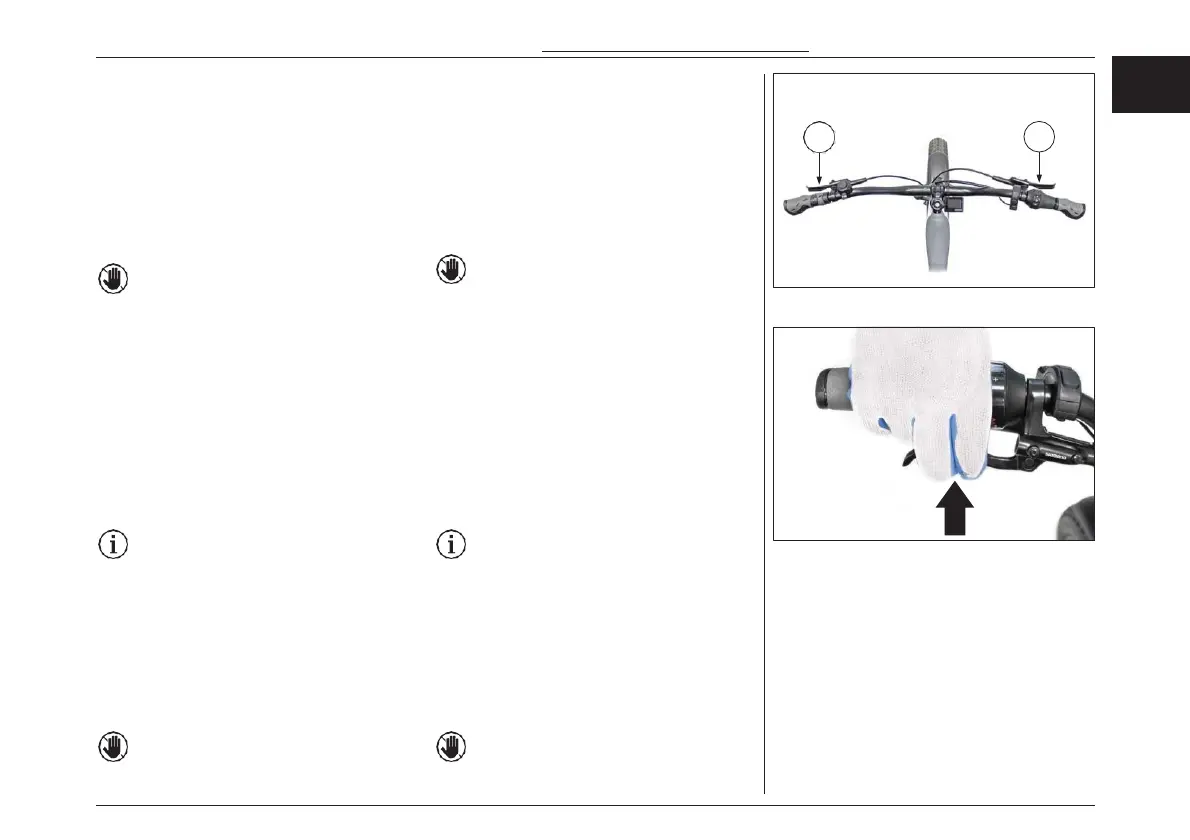
A B
USE OF BRAKES
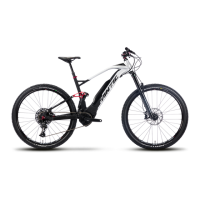
To activate a brake pull the respective lever in the
direction of the handlebar:
– Front brake lever “A”.
– Rear brake lever “B”.
The maximum braking performance is achieved
by simultaneously operating the two levers.
65% (approximately) of the total braking force is
obtained from the front brake.
Danger of falls and accidents. Applying
the brake too hard can cause the wheels
to block and cause slippage or overturn-
ing. It is necessary to become familiar
with the brakes operation. Begin by
pedalling slowly and applying the brake
levers with moderation. Perform these
braking exercises on flat road surfaces
with low traffic. Measure the brakes and
apply the two levers simultaneously. Be
careful when applying the front brake
lever; the presence of sand, gravel, etc.
could make the front wheel slip causing
a fall.
Disc brakes fully achieve their braking
action after a certain “break-in phase”.
The general rule is the following: The
brakes are considered run-in after about
30 short complete braking actions start-
ing from an average speed (about 25
km/h). Avoid long trips if the brake sys-
tem has not been run-in. Once the brak-
ing system has been run-in, a very high
braking force will be available.
Applying the brake levers too hard can
block the wheels.
ブレーキの使用法
ブレーキを作動させるには、それぞれのレバー
を ハンドルバーの方向に引きます。:
– フロントブレーキレバー「A」。
– リアブレーキレバー「B」。
2 つのレバーを同時に操作することで、最大の
ブレーキ性能が得られます。
全制動力の約65%がフロントブレーキから得ら
れます。
転倒や事故の危険性があります。ブレー
キを強くかけすぎると、車輪が止まってス
リップしたり、横転したりする恐れがありま
す。ブレーキの操作に慣れておく必要が
あります。最初はゆっくりとペダルを踏み、
適度にブレーキレバーを引くことから始め
てください。これらのブレーキ操作は、交
通量の少ない平坦な路面で行ってください。
制動力を測り、2つのレバーを同時にかけ
ます。前輪のブレーキレバーの操作には
注意してください。砂や砂利などがあると
前輪がスリップして転倒することがありま
す。
ディスクブレーキは、一定の「慣らし」の段
階を経て、完全な制動力を発揮します。
一般的なルールは以下の通り です 。ブ
レーキは平均速度(約25km/h)から約
30回の短い完全制動動作を経て、慣らし
運転されたとみなされます。ブレーキシス
テムが慣らし運転されていない場合は、
長時間の走行は避けてください。ブレーキ
システムが作動すると、非常に高い制動
力が得られるようになります。
ブレーキレバーを強くかけすぎると、ホ
イールをロックしてしまうことがあります。
バイクに乗ってみよう- USING YOUR BICYCLE
41
EN
JPN


 To Next Page