76 SEBU8325-01
Maintenance Section
V-Belts - Inspect/Adjust/Replace
For options reg
arding the removal, installation, and
replacement, consult your Perkins dealer or your
Perkins distributor. Refer to the Disassembly and
Assembly Manu
al, “Turbocharger - Remove and
Turbocharger - Install” for further information.
Inspecting
NOTICE
The compres
sor housing for the turbocharger must
not be removed from the turbocharger for cleaning.
The actuat
or linkage is connected to the compressor
housing. If the actuator linkage is moved or disturbed
the engine may not comply with emmissions legisla-
tion.
1. Remove the pipe from the turbocharger exhaust
outlet and remove the air intake pipe to the
turbocha
rger. Visually inspect the piping for the
presence of oil. Clean the interior of the pipes
in order to prevent dirt from entering during
reassem
bly.
2. Check for the presence of oil. If oil is leaking from
the back
side of the compressor wheel, there is a
possibility of a failed turbocharger oil seal.
The pre
sence of oil may be the result of extended
engine operation at low idle. The presence of oil
mayalsobetheresultofarestrictionoftheline
for the
intake air (clogged air filters), which causes
the turbocharger to slobber.
3. Inspe
ct the bore of the housing of the turbine
outlet for corrosion.
4. Fast
en the air intake pipe and the exhaust outlet
pipe to the turbocharger housing.
i02690446
V-Belts - Inspect/Adjust/
Replace
Inspection
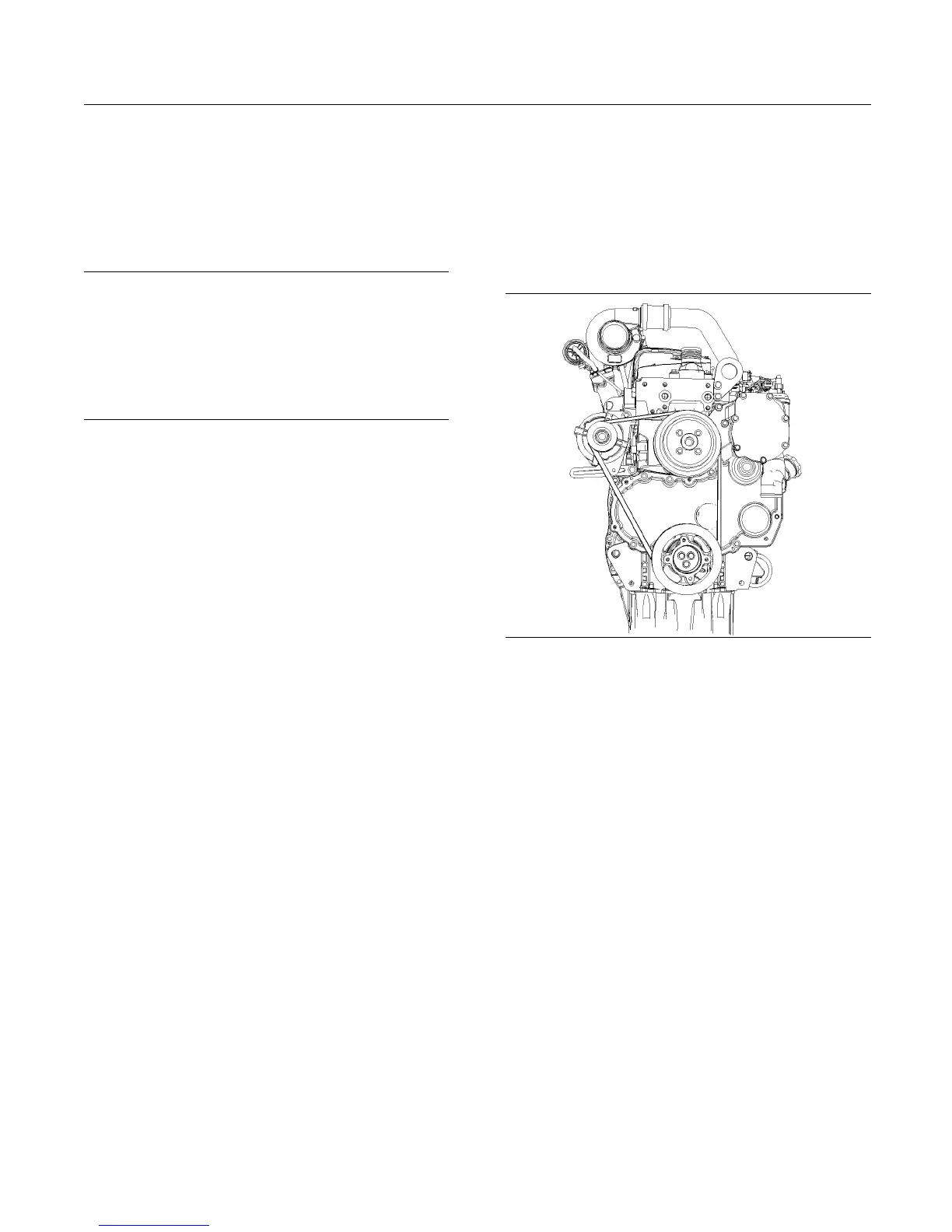
g01249073
Illustration 43
Arrangement for the V-belts
To maximize the engine performance, inspect the
belts for wear and for cracking. Replace belts that are
worn or damaged.
For applications that require multiple drive belts,
replace the belts in matched sets. Replacing only
one belt of a matched set will cause the new belt to
carry more load because the older belt is stretched.
The additional load on the new belt could cause the
new belt to break.
If the belts are too loose, vibration causes
unnecessary wear on the belts and pulleys. Loose
belts may slip enough to cause overheating.
To accurately check the belt tension, a suitable gauge
should be used.


 To Next Page