Limitorque
®
MX Electronic Actuator FCD LMENIM2306-09-AQ – 08/17
81
flowserve.com
Input 2 (normal default - Close Inhibit) terminal 35:
• Set as enabled, partial stroke enable function, signal absent = active
The partial stroke enable signals are setup as redundant signals for safety. There are two signal inputs, and BOTH must
be in the active state. If the partial stroke enable inputs are in the active state, and an input is detected (>800 ms) on the
momentary ESD/PSESD input, then a partial stroke ESD test will be run. If the partial stroke enable inputs are not active
or in a fault state, and an input is detected on the momentary ESD/PSESD input, then the ESD will be latched in and the
actuator will perform ESD until the ESD Release is given.
NOTE: These three inputs are the normal open-close-stop inputs. When this custom mode is enabled, they are set to
the predefined configuration and cannot be changed by the customer. The only change the customer can make is to
set the momentary ESD action (if action is position - then also the target value for the ESD) and the partial stroke target
value.
Input 3 (normal default - stop) terminal 26:
• Set as enabled, ESD release function, signal absent = active
Input 4 (normal default - open) terminal 25:
• Set as enabled, ESD Release function, signal present = active
Input 5 (normal default - close) terminal 27:
• Set as enabled, momentary ESD/PSESD function, signal present> 800 ms = active, ESD action =
Close, partial stroke target position = 0% open The ESD release signals are setup as redundant signals for safety. There
are two signal inputs, and BOTH must be in the active state. If there is an active ESD and both ESD release inputs are in
the active state, the ESD will be unlatched and the unit will return to normal operation. If the ESD release inputs are in
a fault state, an active ESD will NOT be released. The ESD release inputs will have no effect on a partial stroke ESD test.
The momentary ESD/PSESD input will be ignored if there is a signal present for less than 100 ms, and is guaranteed to
latch in the ESD/PSESD if the signal is present for greater than 800 ms. Once the ESD is latched in, the unit will perform
the ESD action. In this case the ESD will move the unit to the close limit and remain in ESD mode until the ESD release
indication is given using the ESD release inputs.
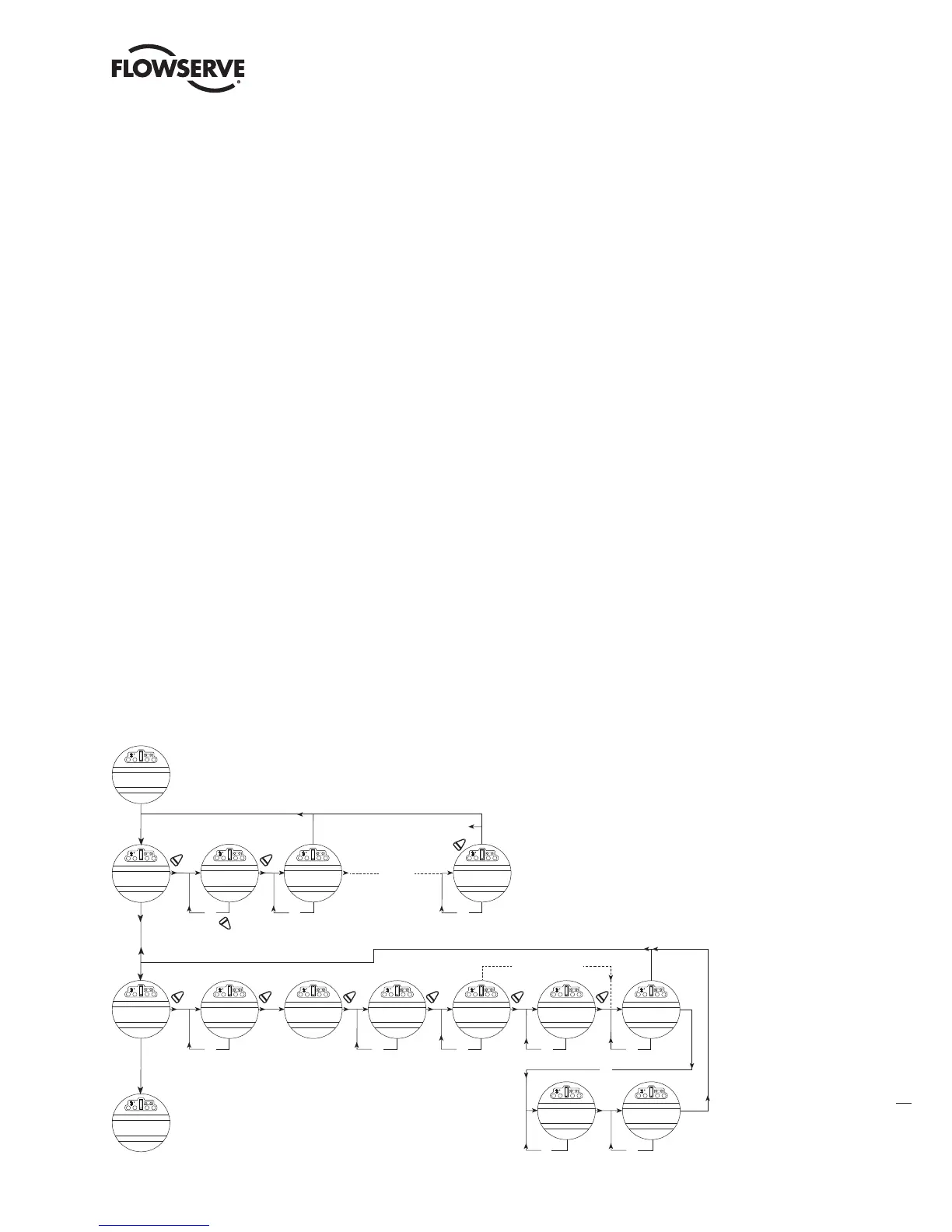
Figure 4.33 – SIL control (Enhanced)
SIL CONTROL
ENHANCED?
STATUS
(OFF)-OK?
STATUS
(OFF)-OK?
STATUS FUNC
USER INPUT-OK?
SIGNAL
PRESENT-OK?
CHANGE
OUTPUT 0?
CHANGE
INPUT-0?
VIEW
DIAGNOSTICS?
YES AND
2 WIRE
OPEN INHIBIT
CLOSE INHIBIT
BOTH INHIBIT
2-WIRE OPEN
2-WIRE CLOSE
NOTES:
NOTE 1: 2 Wire controls are not selectable is DDC, PBCP, PBPA,
Devicenet, FF, or Maclulating controls are enabled.
SEE NOTE 1
YES AND
NOT 2 WIRE
SEE NOTE 1
ABSENT
YES AND NOT POSITION
IGNORE
CLOSE
OPEN
STOP
YES
YES YES
OFF
YES YES YES YES
YES
YES
YES
ABSENT
NO
NO
NONO
STATUS FUNC USER
MO ESD/PSESO-OK?
NO
SIGNAL
PRESENT-OK?
NO
ESD ACTION
POSITION-OK?
NO
ESD MORE TO
XXX%-OK?
NO
PROP BAND
XXX%-OK?
DEAD BAND
XXX%-OK?
PS MOVE TO
XXX%-OK?
NO
YES
LMENIM2306-09 AQ.indd 81 Mittwoch23.08.17 08:53




 To Next Page