EasyManua.ls Logo

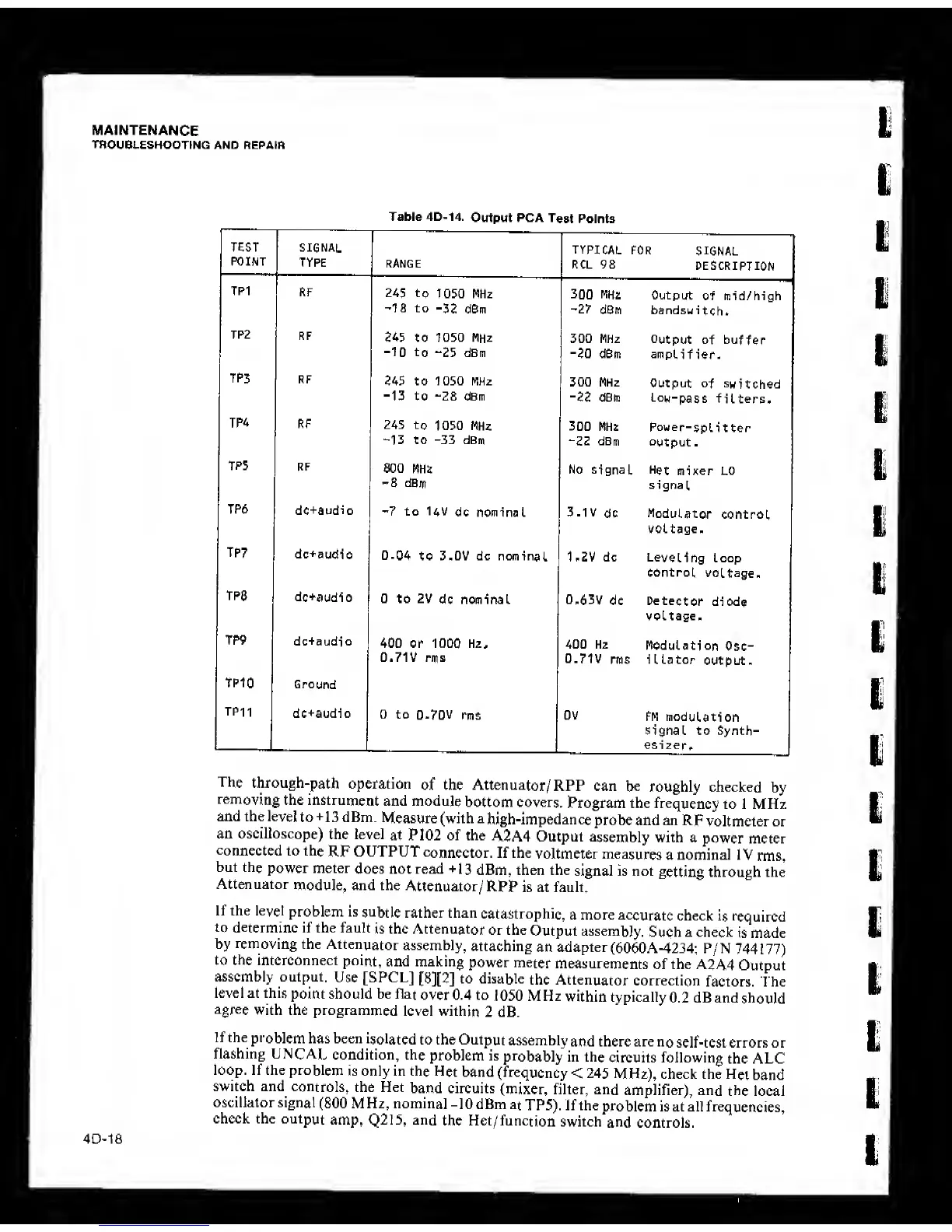
Fluke 6060B - Output RCA Test Points

Fluke 6060B
312 pages
Print Icon
To Next Page IconTo Next Page
To Previous Page IconTo Previous Page
Loading...
MAINTENANCE
TROUBLESHOOTING
AND REPAIR
Table 4D-14.
Output PCA
Test
Points
TEST
POINT
SIGNAL
TYPE
RANGE
TYPICAL
FOR
SIGNAL
RCL 98
DESCRIPTION
TPI
RF
245 to
1050 MHz
-18
to -52
dBm
300 MHz
“27
dBm
Output
of mid/high
bandsuitch.
TP2
RF
245 to 1050 MHz
-1
0
to
“25
dBm
300 MHz
-20
dBm
Output
of
buffer
amplifier.
TP3
RF
245 to 1050 MHz
-13
to
“28
dBm
300 MHz
-22
dBm
Output
of switched
low-pass
filters.
TP4
RF
245
to
1050 MHz
-13
to
-33
dBm
300
MHz
“22
dBm
Power-splitter
output
.
TPS
RF
800 MHz
”8
dBm
No Signal
Het
mixer LO
signal
TP6
dc+audio
-7
to
14V
dc nominat
3.1V
dc Modulator
control
voltage.
TP7
dc+audio
0-04
to 3.0V dc nominal
1.2V dc
Leveling
Loop
control
voltage.
TP8
dc+audio
0 to 2V
dc nominal
0.63V dc
Detector
diode
voltage.
TP9
dc+audio
400 or 1000 Hz,
0i71V rms
400 Hz
0.71V
rms
Modulati
on Osc-
i L Lator
output
.
TP10
Ground
TP11
dc+audio
0 to 0.70V
rms QV
FM
modulation
signal to Synth-
esizer.
The
through-path
operation
of the Attenuator/
RPP can
be
roughly checked
by
removing
the instrument
and module
bottom covers.
Program the
frequency
to 1 MHz
and the
level
to + 1 3 d Bm.
Measure (with a
high-impedance
probe and an
R
F voltmeter or
an oscilloscope)
the level
at PI02 of the
A2A4 Output
assembly
with a
power meter
connected
to the
RF OUTPUT
connector.
If the
voltmeter
measures
a nominal 1
V rms,
but the
power meter
does not read +13
dBm, then the
signal is not
getting through the
Attenuator
module, and the
Attenuator/
RPP
is at fault.
If the level
problem is
subtle
rather than
catastrophic,
a more
accurate
check is
required
to determine
if the fault
is the Attenuator
or the
Output assembly.
Such a check
is made
by
removing
the
Attenuator
assembly,
attaching
an adapter
(6060A-4234: P/N
744177)
to the interconnect
point,
and making
power
meter
measurements
of the
A2A4
Output
assembly output.
Use [SPCL]
[8][2]
to disable
the
Attenuator
correction
factors. The
level at this
point should be Fat
over 0.4 to
1050 MHz
within typically
0.2 dB and
should
agree
with the programmed
level within
2 dB.
If the
problem
has been
isolated
to the Output
assembly
and there are
no
self-test errors or
flashing UNCAL
condition, the
problem is
probably
in the
circuits following
the ALC
loop. If the
problem
is only in the
Het
band
(frequency
<
245
MHz), check the
Het
band
switch and
controls,
the Het
band circuits
(mixer, filter, and
amplifier), and
the
local
oscillator signal
(800 MHz, nominal -10
dBm
at
TP5). If the
problem is at all
frequencies,
check the output
amp,
Q215,
and
the Het/function
switch
and
controls.
I
I
E
E
1
E
E
E
4D-18

Table of Contents

Related product manuals