INSTALLATION AND OPERATION
I
I
I
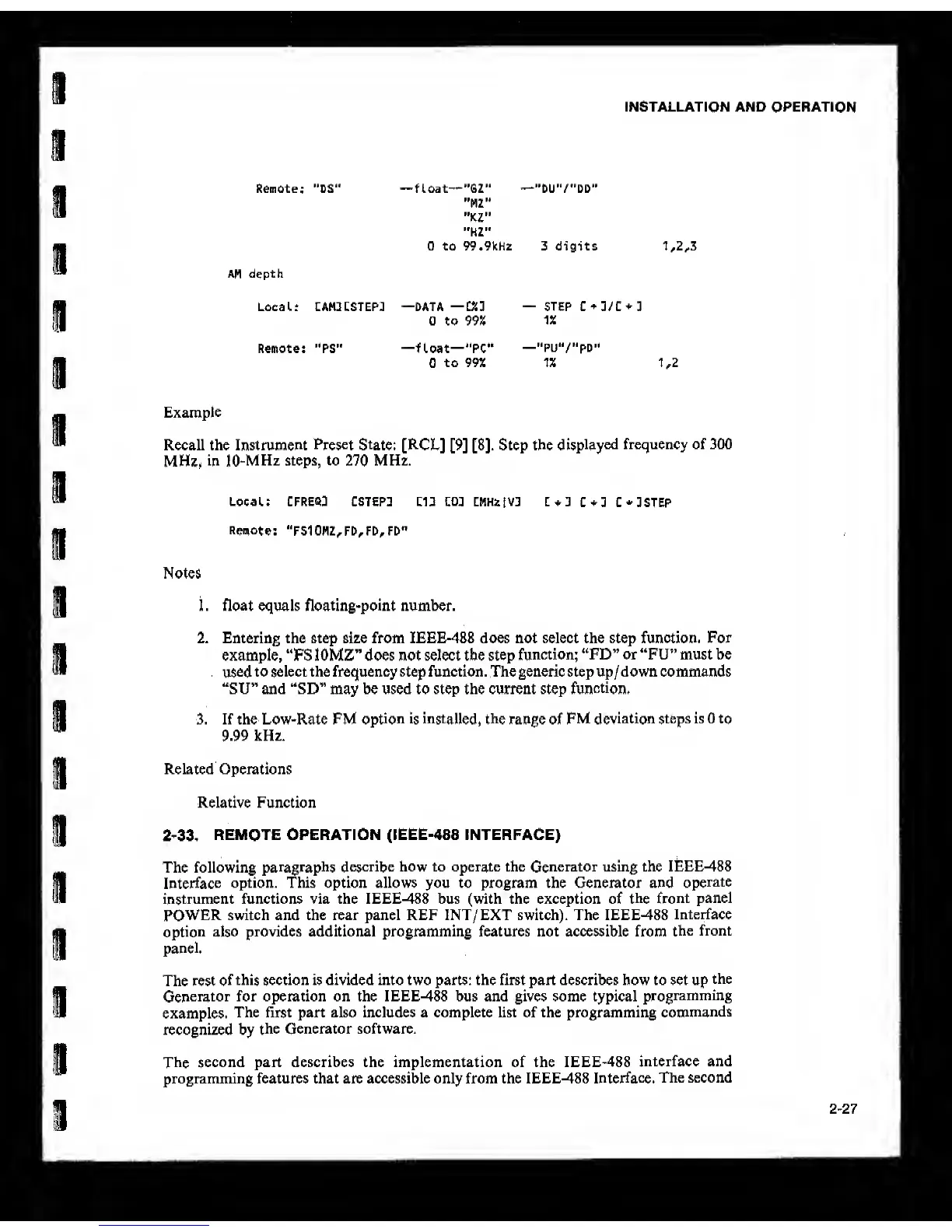
Remote; "DS" —fLoat~"G2"
"HZ"
"KZ"
"HZ"
0 to 99.9kHz
—
"0U"/"DD"
I digits 1
/
2,3
AH
depth
Local; CAM2LSTEPJ “DATA —L%1
0 to 99%
—
STEP
1 %
Remote; "PS" —float—"PC'*
—
"pu"/"pD"
0
to 99% n
1/2
Example
Recall the Instrument
Preset State:
[RCL]
[9]
[8],
Step the
displayed
frequency of 300
MHz,
in
10“MHz steps, to
270
MHz.
Local: CFREQ: CSTEP3 COJ CMHZ1V3 1*1
C+] C*3STEP
Remote:
'*FS10HZ,FD,F0,FD"
Notes
1. float equals floating-point number.
2. Entering the step size from IEEE-488 does not select the step function. For
example, “FSIOMZ” does not select the step
function; “FD” or “FU” must be
used
to select the frequency step function. The generic step up
/
down commands
“SU” and “SD” may be used to step the current step
function.
3. If the Low-Rate FM
option is installed, the
range of
FM
deviation steps is 0
to
9.99 kHz.
Related Operations
Relative Function
2-33.
REMOTE OPERATION (IEEE-488 INTERFACE)
The following
paragraphs
describe how to operate the Generator using the IEEE-488
Interface
option. This option allows you to program the Generator and
operate
instrument functions via the IEEE-488 bus (with the exception of
the front
panel
POWER switch and the rear panel REF INT/EXT switch). The IEEE^88
Interface
option also
provides additional programming features not accessible from
the front
panel.
The rest
of
this section is divided into two parts: the first part describes how to set up
the
Generator for operation on the IEEE-488 bus and gives some typical
programming
examples.
The first part also includes a complete list of the programming
commands
recognized by
the Generator software.
The
second part describes the implementation of the IEEE-488
interface and
programming features that are accessible only from the IEEE-488
Interface.
The second
2-27



 To Next Page