INSTALLATION AND OPERATION
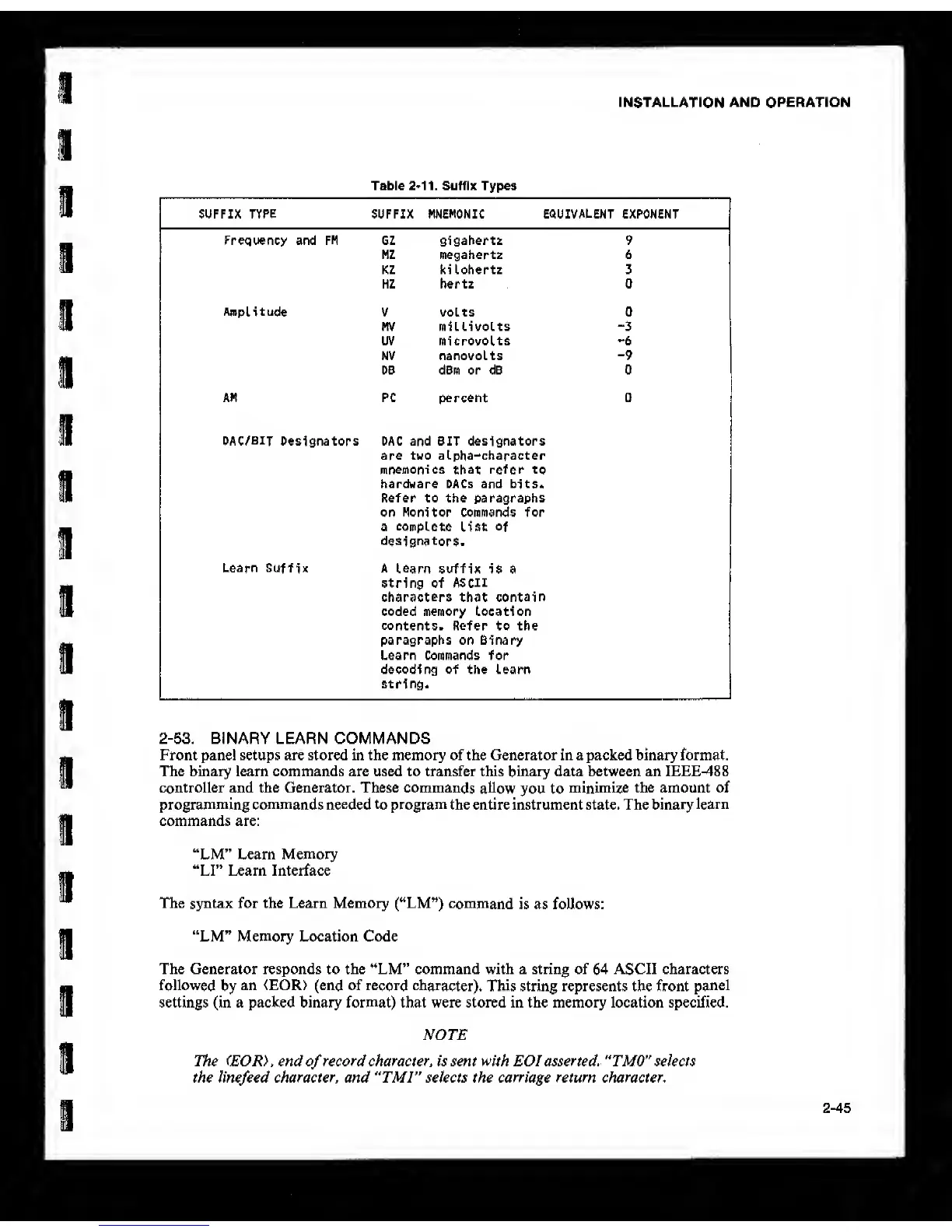
Table
2*11.
Suffix Types
SUFFIX TYPE SUFFIX MNEMONIC EQUIVALENT EXPONENT
Frequency and FH GZ gigahertz 9
MZ megahertz 6
KZ ki Lohertz 3
HZ hertz 0
Amplitude
V volts 0
MV millivolts
“3
UV microvolts
**6
NV nanovolts
-9
DB dBm or dB 0
AM PC
percent
0
DAC/BIT
Designators DAC and BIT designators
are two alpha-character
mnemonics that refer to
hardware DACs and bits.
Refer to the paragraphs
on Monitor Commands for
a complete
list
of
designators.
Learn Suffix A
learn
suffix is a
string of
ASCII
characters
that
contain
coded memory location
contents. Refer to
the
paragraphs on Binary
Learn Commands for
decoding of the Learn
string.
2-53.
BINARY LEARN COMMANDS
Front panel setups are stored in the memory of the Generator in a packed binary format.
The binary learn commands are used to transfer this binary data between an IEEE-488
controller and the Generator. These commands
allow
you to
minimize the amount of
programming commands
needed to
program the entire instrument state. The binary
learn
commands are:
“LM” Learn Memory
“LI” Learn Interface
The syntax for the Learn Memory (“LM”)
command
is as follows:
“LM” Memory Location Code
The Generator responds to the “LM” command with a string of 64 ASCII characters
followed
by
an <EOR> (end of
record character).
This string represents the front
panel
settings (in a packed binary format) that were stored in the memory location specified.
NOTE
The <EOR>
,
end
of
record character, is sent with EOIasserted. **TM0’' selects
the linefeed character, and **TM1" selects the carriage return character.
2-45



 To Next Page