INSTALLATION
AND OPERATION
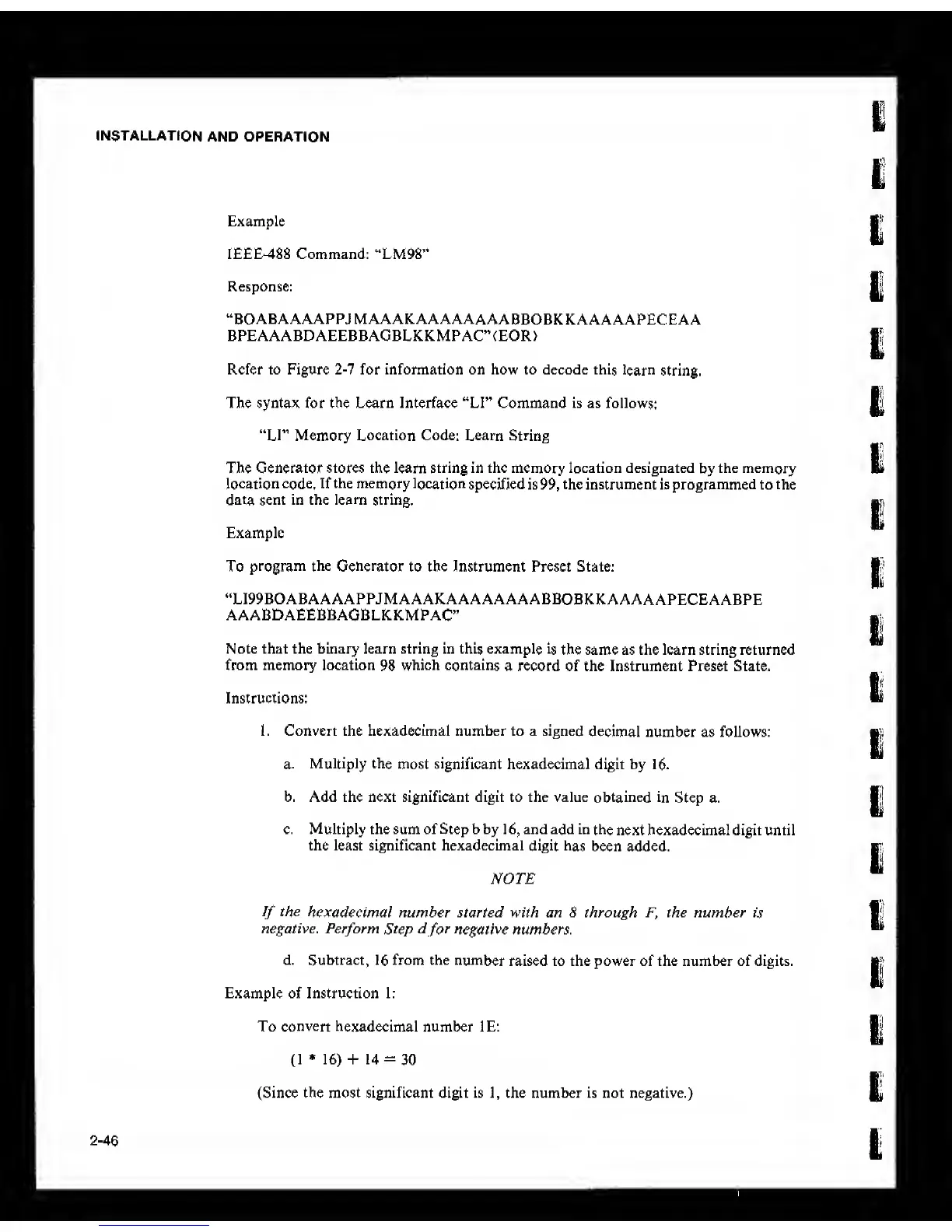
Example
IEEE488 Command: “LM98”
Response:
“BOABAAAAPPJMAAAKAAAAAAAABBOBKKAAAAAPECEAA
BPEAAABDAEEBBAGBLKKMPAC”(EOR)
Refer to Figure
2-7
for information on how to decode this
learn
string.
The syntax for the Learn Interface “LI” Command is as follows:
“LI” Memory Location Code: Learn String
The Generator stores the learn string in the memory location designated by the memory
location code. If
the memory
location
specified is
99,
the instrument is programmed to the
data sent
in the learn
string.
Example
To
program
the
Generator
to the Instrument Preset State:
“LI99BOABAAAAPPJMAAAKAAAAAAAABBOBKKAAAAAPECEAABPE
AAABDAEEBBAGBLKRMPAC’
Note that the binary learn string in this example
is
the same as the learn string returned
from memory location
98
which contains
a record of the Instrument Preset State.
Instructions:
1. Convert the hexadecimal number to a signed
decimal number as follows:
a.
Multiply the
most significant hexadecimal digit by 16.
b. Add the next significant digit to the value
obtained in
Step a,
c. Multiply thesumofStepbby
16,
and add in
the
next hexadecimal digit until
the least significant hexadecimal
digit has
been added.
NOTE
If
the
hexadecimal number started with an 8 through F, the number
is
negative. Perform
Step
d
for negative numbers,
d. Subtract,
16
from the
number
raised to the power of the number of digits.
Example of Instruction I:
To
convert hexadecimal
number IE;
(1
•
16)
+ 14
=
30
(Since the most significant digit is
1,
the number is not negative.)
E
2-46



 To Next Page