INSTALLATION AND OPERATION
The header is always required, but the numeric and suffix may
be
optional. This
rule gives
the following four possible combinations:
{HEADER)
{HEADER) {NUMERIC)
{HEADER) {NUMERIC) SUFFIX)
{HEADER) (SUFFIX)
Multiple commands may be separated with one
of
the end of string (EOS) characters
or Use of EOS
characters facilitates
recovery in the event of a syntax error and will
also enhance readability.
2-49.
COMMAND HEADER SYNTAX
The command header is a two alpha-character string.
A list of the IEEE^88 command
headers used on the Generator is presented in
Table
2-8.
The header determines the
syntax of the numeric and suffix as listed in
the
table.
2-50.
NUMERIC DATA SYNTAX
There are
four types
of
numeric
data: Boolean, unsigned integer, floating point, and
trigger string. The following paragraphs describes each
of
the
four numeric data formats.
A syntax
diagram is
included
for each format.
1.
Boolean
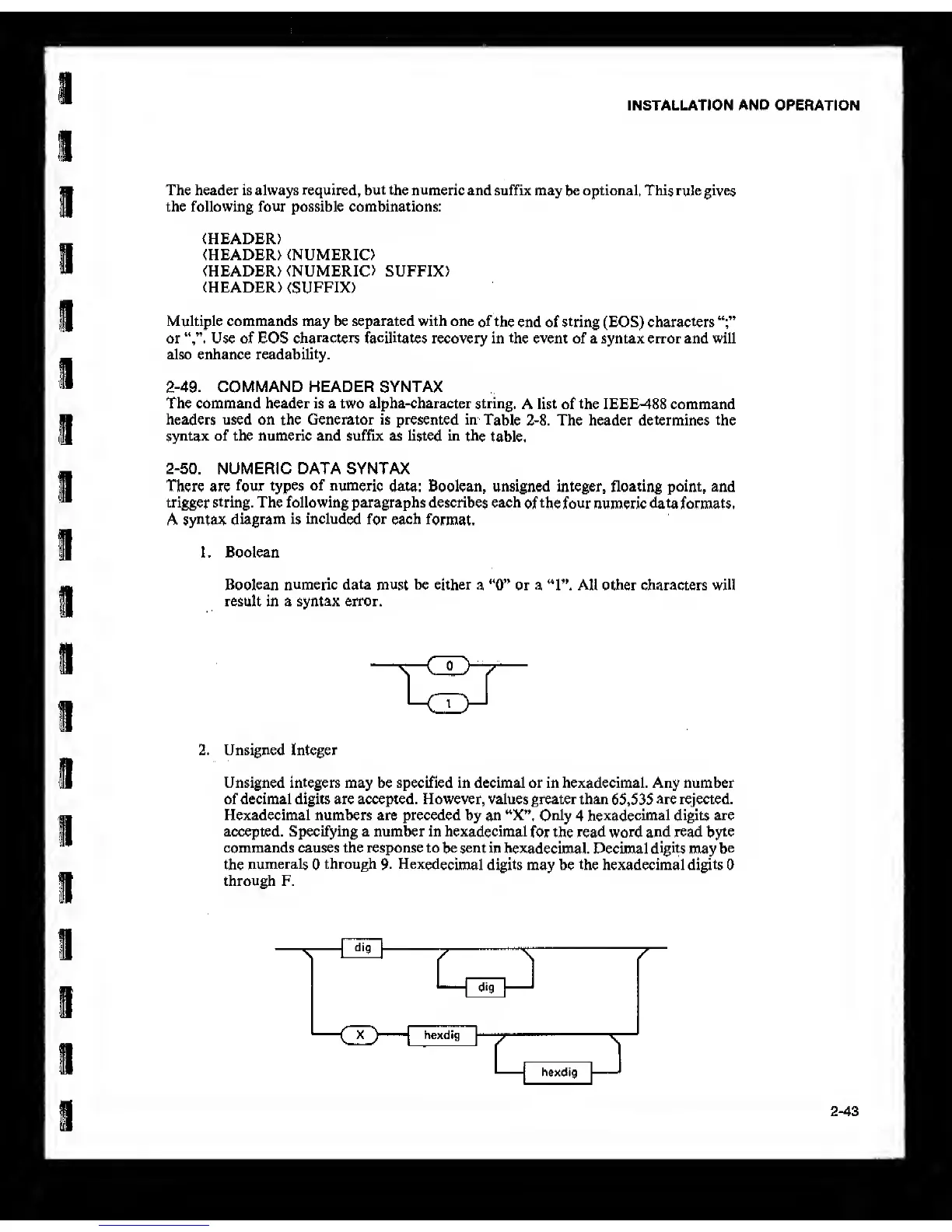
Boolean numeric data must be either
a
“0”
or a ''*V\ All other characters will
result in a syntax error.
2. Unsigned Integer
Unsigned integers may be specified in decimal or in hexadecimal. Any number
of decimal digits are accepted. However, values greater than
65,535
are rejected.
Hexadecimal numbers are preceded by
an
“X”. Only
4
hexadecimal digits are
accepted. Specifying a number in hexadecimal
for the read word and
read
byte
commands causes the response to
be sent in
hexadecimal. Decimal
digits
may
be
the
numerals
0
through 9.
Hexedecimal
digits may be the hexadecimal digits 0
through F.
2-43



 To Next Page