Rev. 5 – Jun 2020 Page 19 of 91
FUMANA
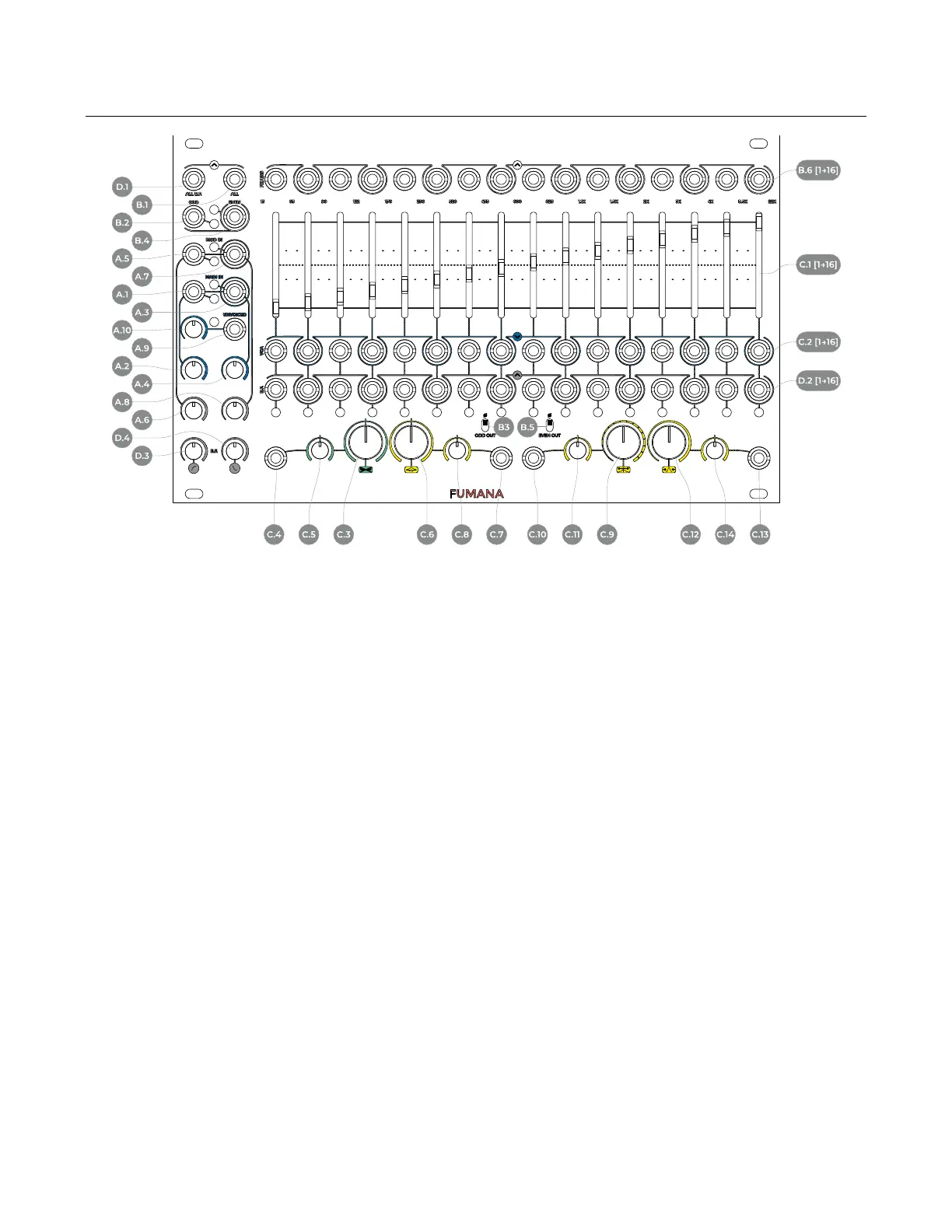
Figure 17: FUMANA interface.
A Audio Inputs
A.1 Main Odd Input
A.2 Main Odd Level
A.3 Main Even Input
A.4 Main Even Level
A.5 Mod Odd Input
A.6 Mod Odd Level
A.7 Mod Even Input
A.8 Mod Even Level
A.9 Unvoiced Input
A.10 Unvoiced Level
B Audio Outputs
B.1 All Output
B.2 Odd Output
B.3 Odd Output Phase
B.4 Even Output
B.5 Even Output Phase
B.6 Individual Band Outputs
C Controls and CV Inputs
C.1 VCA Faders
C.2 VCA CV Inputs
C.3 Tilt Control
C.4 Tilt CV Input
C.5 Tilt CV Input Attenuverter
C.6 Peak/Notch Control
C.7 Peak/Notch CV Input
C.8 Peak/Notch CV Input Attenuverter
C.9 Center Control
C.10 Center CV Input
C.11 Center CV Input Attenuverter
C.12 Width Control
C.13 Width CV Input
C.14 Width CV Input Attenuverter
D Controls and CV Outputs
D.1 All Envelope Followers Output
D.2 Individual Envelope Followers
Outputs
D.3 Envelope Followers Rise Control
D.4 Envelope Followers Fall Control
1 PHILOSOPHY AND DESIGN
FUMANA is a dual all-analog fixed filter bank. Each
filter bank is composed of an array of 16 independent
bandpass filters tuned to specific frequencies.
FUMANA is designed around one basic core principle:
modify the spectral content of the incoming audio signal
by filtering it through 16 bandpass filters in parallel and
then vary the amplitude of each resulting band.
Even though this core principle is relatively simple, the
key feature of FUMANA is that it provides a wide set of
controls over the bands’ amplitude: the spectral content
of the incoming sound can be thus modified by the faders,
which are individually CV-controllable; by the envelope
followers which are generated by the analysis of the sound
patched in the Modulation input; by the global paramet-
ric controls such as Tilt and Scan.
Furthermore, a flexible input/output signal routing al-
lows the musician to “split” the 16 filters into two 8-band
spectral processors by grouping the odd and even bands
separately. It will be possible to process two independent
signals, or to blend two signals into one output, or even
to perform two different sonic treatments over the same
signal and route it to two different output sections.
Individual outputs are available for each band, both for
the Main sound (i.e. the filtered one) and for the Mod
sound (i.e. the resulting envelopes).
Since a spectral transfer tool may be used as a “vocoder-
like-effect”, the FUMANA provides an input for an


 To Next Page