Rev. 5 – Jun 2020 Page 77 of 91
modulator (semi-normalled to the green sine wave) can
be either unipolar or bipolar. Further down the line, it
can be said that the modulating signal can perform either
Amplitude Modulation (when unipolar) or Ring Modu-
lation (Bipolar).
The difference with FALISTRI’s Four Quadrant Mul-
tiplier is that, while its modulation type changes accord-
ing to the signal patched in (bipolar for RM, unipolar for
AM), here the expected signal is always 10V peak-to-
peak, which is then internally scaled to perform the two
tasks via a dedicated switch (G.3).
At its upper position, the switch scales the modulating
signal on the positive side only, thus engaging only two
quadrants and performing amplitude modulation. Set it
to the lower position to make it bipolar, engage the four
quadrants, and perform ring modulation.
For the differences between AM and RM, please refer
to its section in the FALISTRI’s manual (§3.2).
5 TRIMMERS
BRENSO is equipped with 23 trimmers for calibration
purposes. Some of them are meant to be operated by
Frap Tools only, while others can be used by expert mu-
sicians who need to fine-tune certain parameters.
The trimmers are not manual potentiometers, therefore not
designed to handle a large number of twists. For this reason,
you must be exactly sure about what you want to achieve
when you put your hands on a trimmer, and you should limit
any trimming operation to the strict necessary.
ACCESSIBLE TRIMMERS
There are 17 trimmers that an expert user can access,
both on the front panel and on the back of the PCB. They
control seven parameters, described in the following par-
agraphs.
5.1.1 Coarse Frequency
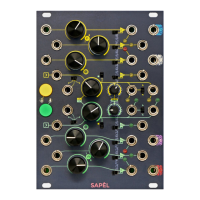
Underneath the two Coarse Frequency Knob, on the
front panel, there are two couples of trimmers labeled m
and M. They control the minimum and maximum value
of the Coarse Frequency knobs of each oscillator, in order
to make them match as close as possible the frequency
scales of the panel label.
5.1.2 Sine Wave Symmetry
Close to the Coarse Frequency Trimmers lie two more
couples of trimmers, one per each oscillator, labeled +
and x: they control the symmetry and gain of the stage
that shapes the triangle wave into a sine wave. By default,
the sine wave is calibrated to be almost pure, but it may
be interesting to alter its shape on purpose to bring in the
second harmonic.
5.1.3 Sawtooth Wave Symmetry
At the upper right corner of the back of the PCB, there
is a trimmer that regulates the symmetry of the green saw-
tooth waveform. As for the sine waves, this is factory cal-
ibrated to an almost-pure sawtooth, but it can be altered
on purpose.
5.1.4 Exponential FM Zero
On the back of the PCB, two trimmers in the lower-
right corner control the DC-Offset compensation for the
external source of exponential frequency modulation.
5.1.5 Triangle Waveshaper Shape
Two trimmers close to the Triangle Waveshaper knob
control the shape of the logarithmic waveform that can
be heard when the knob is at the rightmost position. This
circuit is borrowed from the FALISTRI module.
5.1.6 Wavefolder Symmetry
This trimmer is located on the back of the PCB and ad-
justs the symmetry of the wavefolding circuit, i.e., the
number of folds that appear on the positive and negative
front of the waveform at a given position of the Wave-
folder knob and when the Symmetry knob is at noon.
5.1.7 Four-Quadrant Multiplier
This trimmer controls the symmetry of the amplitude
and ring modulations: it is used to make sure that, when-
ever the modulating signal reaches 0V, the modulated
one is as closest possible as its un-modulated version.
To calibrate the Amplitude Modulation circuit, patch a
dummy cable to the second input of the Amplitude Modu-
lation section, and set the modulation amount fully clock-
wise, and trim it to reach the lowest possible amplitude.
5.1.8 Comparator
This circuit prevents the oscillator core from stalling by
controlling the direction of the negative front of the bipo-
lar waveform. The trimmer regulates the position of the
threshold below which the triangle wave is detected as
negative by the oscillator core.
Due to common factors such as power or ground distri-
bution, it may happen that an oscillator stalls when set at
low frequencies and modulated with a carrier with sharp
transients. In this case, gently rotate this trimmer (labelled
Core Comp) counterclockwise with a trim pot screwdriver
until the oscillator is heard again. If you have troubles
with this operation contact us at support@frap.tools.
NON-ACCESSIBLE TRIMMERS
There are six more trimmers that must not be touched
for any reason, because it will void the module’s war-
ranty. They control the crucial parameters of the oscilla-
tors and are carefully calibrated by our technicians: if
modified, they may cause BRENSO to behave in a wrong


 To Next Page