Reference
44
GPS Info Page
Understanding the GPS Information Page
What is GPS?
The Global Positioning System (GPS) is a satellite-based navigation system made up of a network of
24 satellites placed into orbit by the U.S. Department of Defense. GPS was originally intended for military
applications, but the government made the system available for civilian use in the 1980s. GPS works in
any weather condition, anywhere in the world, 24 hours a day. There are no subscription fees or setup
charges to use GPS.
GPS satellites circle the earth twice a day in a very precise orbit and transmit signal information to
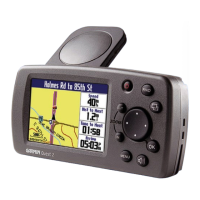
Earth. The GPS receiver that is located in your Quest takes this information and uses triangulation to
calculate your exact location. Essentially, the GPS receiver compares the time a signal was transmitted by a
satellite with the time it was received. The time difference tells the GPS receiver how far away the satellite
is. Now, with distance measurements from a few more satellites, the receiver can determine your position
and display it on the Quest’s Map page.
A GPS receiver must be locked on to the signal of at least three satellites to calculate a 2D position (lati-
tude and longitude) and track movement. With four or more satellites in view, the receiver can determine
your 3D position (latitude, longitude and altitude). Once your position has been determined, the GPS unit
can calculate other information, such as speed, bearing, track, trip distance, distance to destination, sunrise
and sunset, time, and more.
The GPS Information Page
The GPS Information page provides a visual reference of GPS receiver functions, including current
satellite coverage, receiver status, and position accuracy. To access this page, press the Quest MENU key
and then select Settings. From the Settings page that appears, select GPS Info and the GPS Information page
appears.
GPS satellites are positioned throughout the sky. As soon as you turn on your Quest, it attempts to
acquire satellite reception. From the sky view area on the GPS Information page, you can see which satel-
lites are currently in your area; each satellite has its own number (from 1-31).
A solid bar indicates the Quest has found the nearby
satellite(s) and has collected the necessary data. Note
how the Quest has not yet found satellites 11 and 19.
190-00323-00_0B.indd 44 8/20/2004, 11:08:37 AM



 To Next Page