GE Power Management LPS-O Line Protection System 1-
9
1 PRODUCT DESCRIPTION 1.4 AUXILIARY PROTECTION FUNCTIONS
1
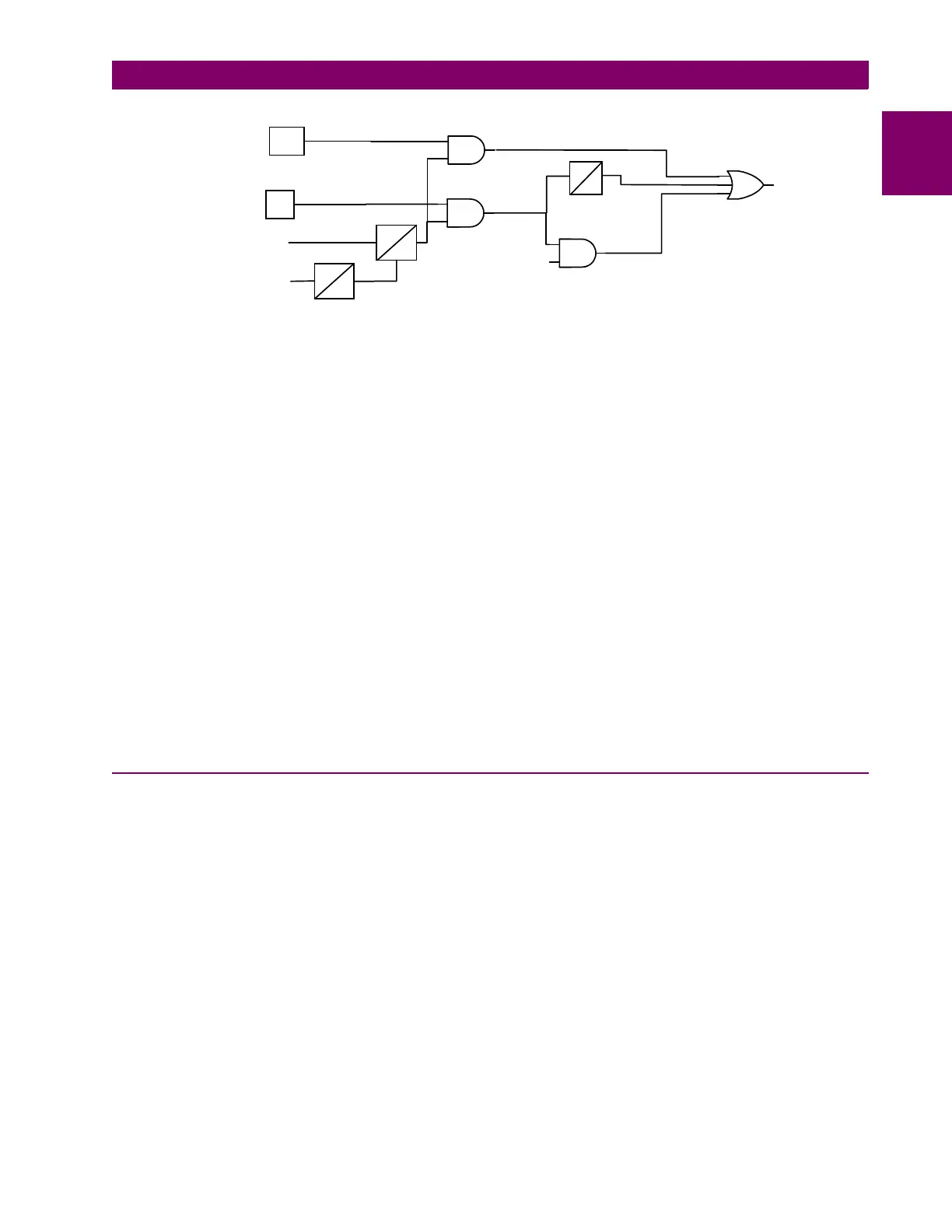
Figure 1–2: LINE PICKUP LOGIC DIAGRAM
When the line is de-energized, the open breaker is detected by the All Phases Open input. The resulting output
causes timer TL401 to pickup 150 ms later. Consequently, when the line is energized and a fault current higher
than the setting of I1 exists, current detector I1 picks up and AND402 produces an output. If the Timer Bypass
setting is set to YES, AND403 immediately produces an output to initiate tripping of the breaker. If the Timer
Bypass setting is set to NO, then tripping occurs after the 45 ms pickup delay of timer TL403. Line Pickup is
primarily intended to trip for closing into zero-voltage bolted faults where the distance functions connected to
line-side potential will not operate. However, regardless of the I1 pickup setting, Line Pickup can also be used
to trip on any type of permanent fault along the entire line length that produces sufficient voltage at the relay
location to operate a Zone 2 distance function, but insufficient to pickup the All Phase Voltages High signal.
This is accomplished by routing Zone 2 phase distance function outputs to AND401. The step distance backup
timers are bypassed by the Line Pickup logic.
If the line is energized and no fault exists, the all Phase Voltages High signal picks up and timer TL401 will
begin timing; 40 ms later the output of TL401 resets timer TL401 via the fast reset input. AND401 and AND402
have their lower input removed at that time to take the Line Pickup out of service.
Timer TL403 is provided for those cases where simultaneous high-speed reclosing is employed at both ends of
the line, and where the I1 function must be set to pick up below the maximum load current that can occur at
that time. TL403 then allows time for the voltage to return to normal and take Line Pickup out of service before
it can trip on load current. If simultaneous high-speed reclosing is not used, timer TL403 can be permanently
bypassed.
1.4.3 REMOTE-OPEN DETECTOR
The Remote-Open Detector (ROD) function issues a trip signal when the remote breaker opens during an
unbalanced internal fault. This function detects that the remote breaker has opened by recognizing charging
current on one or more phases following opening of the remote breaker. The Remote-Open Detector will not
operate when a balanced three phase fault is present.
ROD tripping can speed up tripping at the end of the line that otherwise would be the slowest to respond in a
sequential-tripping condition. In a Step Distance scheme, ROD tripping is beneficial for any unbalanced inter-
nal fault not detected by Zone 1.
Figure 1–3: REMOTE-OPEN DETECTOR LOGIC below is a functional logic diagram of the ROD function. The
sequence of events that results in an ROD output is as follows:
1. No charging current is detected prior to the fault – logic 0 output from AND2.
2. A fault is detected – logic 1 output from ANY ZONE2 PHASE-DISTANCE FUNCTION.
3. The remote breaker opens – logic 1 output from AND3.
4. The fault is still present, so the two inputs to AND4 persist for the time-delay setting of timer TL20.
TIMER
BYPASS
45
5
150
90
40
0
MT
I1
ALL PHASE VOLTAGES
HIGH
ALL PHASES OPEN
I1 CURRENT
DETECTOR
OVERREACHING PHASE
DISTANCE
LINE PICKUP
TRIP
401
402
403
401
TL403
TL401
TL402
FAST
RESET



 To Next Page