2-
4
LPS-O Line Protection System GE Power Management
2.2 GENERAL SETTINGS 2 CALCULATION OF SETTINGS
2
107: NUM_MON - Trip Outputs To Be Monitored
Trip circuit monitoring can be used to check the integrity of the trip circuit to which the selected trip output is
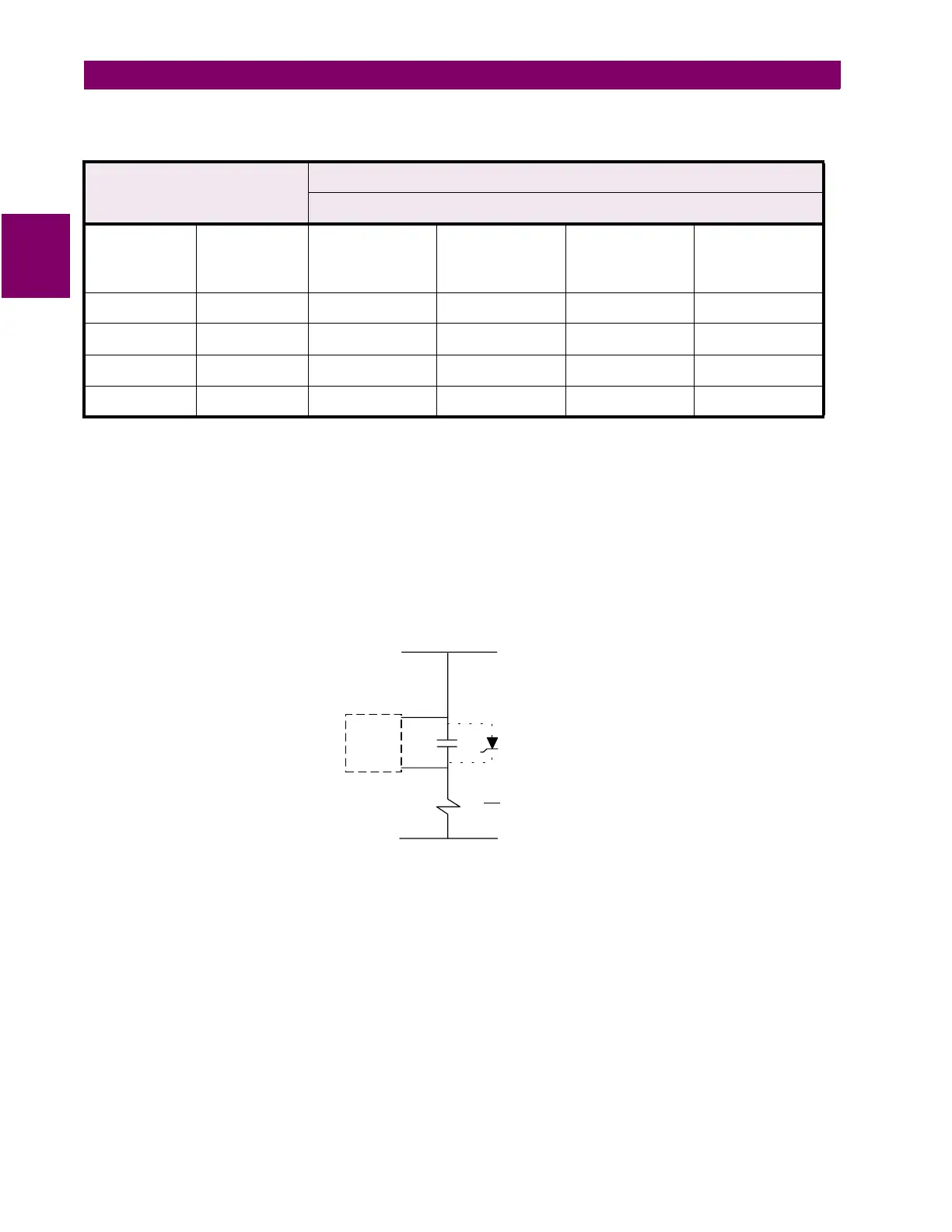
connected. It does this by sensing the voltage across the trip output as shown in Figure 2–1: TRIP CIRCUIT
MONITOR. If the trip circuit is intact, almost full DC voltage will be detected across the trip output. If the trip cir-
cuit is open for some reason, there will be no voltage (or very little voltage) across the trip output. The monitor-
ing circuit will detect this condition and store an event. It can also can be programmed to close an alarm
contact if so desired.
Figure 2–1: TRIP CIRCUIT MONITOR
The trip contacts are also monitored when a trip is initiated by the LPS-O system. If the voltage across the con-
tacts does not drop when the trip is initiated, then it is assumed that the trip circuit is not intact and an alarm is
issued. If the voltage does drop concurrently with the trip initiation, then the trip circuit is considered to have
been activated and no alarm is issued.
Any or all of the outputs (T1 to T4) can be monitored regardless of whether or not they are used in a trip circuit.
The setting format for
NUM_MON
is
abcd
, where any position can be a zero (0) or a one (1) as shown in Table
2–2: SETTING FORMAT FOR NUM_MON.
Table 2–1: TRIPPING SCHEMES
Trip Output Assignments
Breaker No. 1 Breaker No. 2
Number of
Breakers
NUM_BKR
Number of
Trip Circuits
NUM_TC
Trip Circuit 1
TC-1
Trip Circuit 2
TC-2
Trip Circuit 1
TC-1
Trip Circuit 2
TC-2
11
T1---
12
T1 T2 - -
21
T1 - T2 -
22
T1 T2 T3 T4
where: TC1, TC2 = Trip Coils; T1 to T4 = LPS-O Trip Outputs
VOLTAGE
MONITOR
52
TC
TRIP OUTPUT
(FROM ALPS)
(+) DC
(-) DC
TRIP OUTPUT
(FROM LPS-O)



 To Next Page