32
3.4 Fuel quality requirements
PERMISSIBLE FUEL
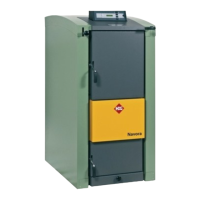
The HDG Compact 25 - 80 heating system is designed for the stan-
dard use of burning wood fuel products made from untreated wood
in the form of wood chips, shavings and wood pellets.
According to §3 (1) 1. In accordance with German Federal Immission
Control Act (BimSchV), the fuel classes 4, 5, 5a, and for the HDG Com-
pact 45/50/65/80 classes 6 and 7 may be used in this heating system.
F
UEL CLASS 4 Untreated log wood including adhering bark, such as wood chips.
F
UEL CLASS 5 Untreated wood (not log wood), such as shavings.
F
UEL CLASS 5A Pellets made of untreated wood in the form of wood pellets or wood
briquettes
F
UEL CLASS 6 Painted, varnished or coated wood including remains thereof, pro-
vided no wood protection agents have been applied or are present
as the result of a treatment, and coatings do not contain organic ha-
logen compounds or containing heavy metals.
F
UEL CLASS 7 Plywood, chipboard, fibreboard or otherwise glued wood including
remains thereof, provided no wood protection agents have been ap-
plied or are present as the result of a treatment, and coatings do not
contain organic halogen compounds or heavy metals.
Fuel classes 6 or 7 may only be used in a wood processing plant at 30
kW or more nominal thermal power. In the case of painted, varnished
or coated wood, it should be noted that greater stress can be placed
on the wearing parts such as wall lining, fill level and lambda sensors,
which may reduce their service lives.
C
OMPOSITION OF THE FUEL Knowledge of the fuel composition forms the basis for the combus-
tion calculation and the treatment of operating issues relating to fi-
ring technology. In addition to combustible substances, the fuels
also contain varying amounts of non-combustible components, so
called inert components
With an increasing ratio of inert components, the thermal tempera-
ture drops considerably, the combustion quality deteriorates, and
the CO emission and the amount of ash and cinder dirt on the hea-
ting surfaces is increased.



 To Next Page