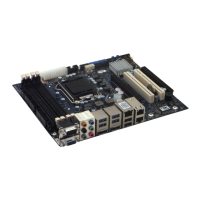
CP3003-V CP3003-SA
Page F - 8 ID 1052-6929, Rev. 3.0
D R A F T — F O R I N T E R N A L U S E O N L Y
F.6 Power Consumption
The goal of this description is to provide a method to calculate the power consumption for the
CP3003-V baseboard and for additional configurations. The processor and the memory dissi-
pates the majority of the thermal power.
The power consumption measurements were carried out using the following testing parame-
ters:
• board installed in an 8-slot passive CompactPCI backplane with two power supplies, one
for the CPU, and the other for the hard disk
• board installed in the system slot
• Ethernet ports not connected
• 3.3 V and 5 V supply voltage
• 2.5 m/s airflow
The operating systems used were uEFI shell and Windows® 7, 64-bit. All measurements were
conducted at a temperature of 25°C. The measured values varied because the power con-
sumption was dependent on the processor activity.
The payload power consumption was measured using the following 2
nd
generation processor:
• Intel® Celeron® 807UE single-core processor, 1.0 GHz, 1 MB L3 cache
with the following firmware and under the following testing conditions:
• CP3003-V in uEFI shell mode
For this measurement the processor core was active (no power management enabled),
the processor graphics controller was in idle state (no application running).
• CP3003-V with Windows® 7, 64-bit, processor and graphics controller in idle state
For this measurement the processor core and the processor graphics controller were in
idle state (no application running), and the processor C3 and C6 states were disabled.
• CP3003-V with Windows® 7, 64-bit, maximum processor workload with basic graphics
operation
For this measurement the processor core was operating at maximum workload and the
processor graphics controller was performing basic operation (e.g. dual screen output
configuration). These values represent the power dissipation reached under realistic,
OS-controlled applications with the processor operating at maximum performance.
• CP3003-V with Win.® 7, 64-bit, maximum processor and graphics controller workload
These values represent the maximum power dissipation achieved through the use of
specific tools to heat up the processor and the integrated graphics controller. These val-
ues are unlikely to be reached in real applications.
Note ...
The power consumption values indicated in the tables below can vary depend-
ing on the ambient temperature or the system performance. This can result in
deviations of the power consumption values of up to 15%.


 To Next Page