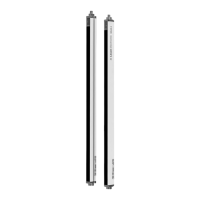
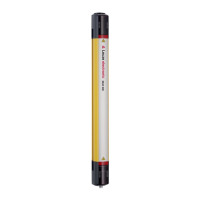
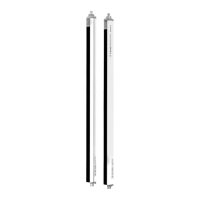
Mounting
Leuze electronic RSL 430 55
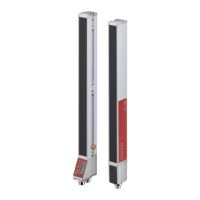
1 BTF815M mounting bracket (only in combination with the BTU800M mounting system)
2 BTU800M mounting system
3 Safety sensor
Fig.7.5: Example: mounting on floor
7.1.5
Information on protective field dimensioning
NOTICE
With protective field boundaries <200mm, object detection may be restricted owing to the mea-
surement error.
Ä When defining the protective field, take into account the additional distance Z
sm
to the pro-
tective field contour (see chapter 7.2 "Stationary danger zone guarding").
Ä Dimension the protective field big enough that the safety sensor's switching signal can stop the danger-
ous movement in good time.
If several protective fields are selected with field pair changeover, this condition applies for all protec-
tive fields.
If you cannot sufficiently dimension a protective field, use additional protective measures, e.g. safety
guards.
Ä Ensure that the protective field cannot be walked behind in the direction of the danger zone.
Ä Observe all delay times, e.g. safety sensor response times, control element response times, braking
times or machine or automated guided vehicle stopping times (AGV).
Ä Take changed delay times, which, for example, can be caused by reducing the braking force, into ac-
count.
Ä Observe shadowing effects, e.g. surfaces and areas behind static objects. People in the shadows of
these objects will not be detected by the safety sensor.
Ä Observe the lateral tolerance when dimensioning the protective fields (see chapter 15 "Technical
data").
Ä Do not use cone-shaped protective field contours, as these do not guarantee any protective function.
Ä Take the additional distances required for the application into account.
Handling unmonitored areas
There is an area behind the safety sensor that the safety sensor does not monitor. Unmonitored areas can
also materialize, e.g. if you install a safety sensor on a rounded off vehicle front.
It must not be possible to walk behind unmonitored areas.


 To Next Page