Operating Instructions – Labmaster
©
130 and MB20G Systems
Instruction Manual
Chapter 3: Principles of Operation
© MBraun, Inc. Edition 1/2007 Page 3-5
Important Notes
• Never open the inner and outer antechamber doors
simultaneously.
• Never open the inner door of an antechamber filled with room
atmosphere. This would result in pollution of the box atmosphere
which could cause damage to instruments and/or materials
inside the box.
• Depending on the materials used inside the glovebox, vapors
may be released into the room when material is transferred into
or out of the glovebox.
Material transferred between the glovebox and room atmosphere
must be able to withstand the pressure difference during the
antechamber purge process (e.g. partially filled vessels, etc.). Open
the seal slightly (e.g. lids of bottles, etc.) to allow the vessel to be
vented to prevent implosion.
3.7 Analyzers
General Information
This section applies only to systems that are equipped with oxygen and/or moisture analyzers.
Each analyzer contains a sensor head that is protected with a metal cap and electronics that are
used to measure (depending on the analyzer type) the oxygen or moisture content of the
working gas inside the glovebox. The analyzers are connected to the PLC via a cable with an
RJ45 connector.
While not all systems are equipped with one or both analyzers at the time of initial installation
they can be purchased at any time. Please contact the M.Braun Sales or Service Department
for further information.
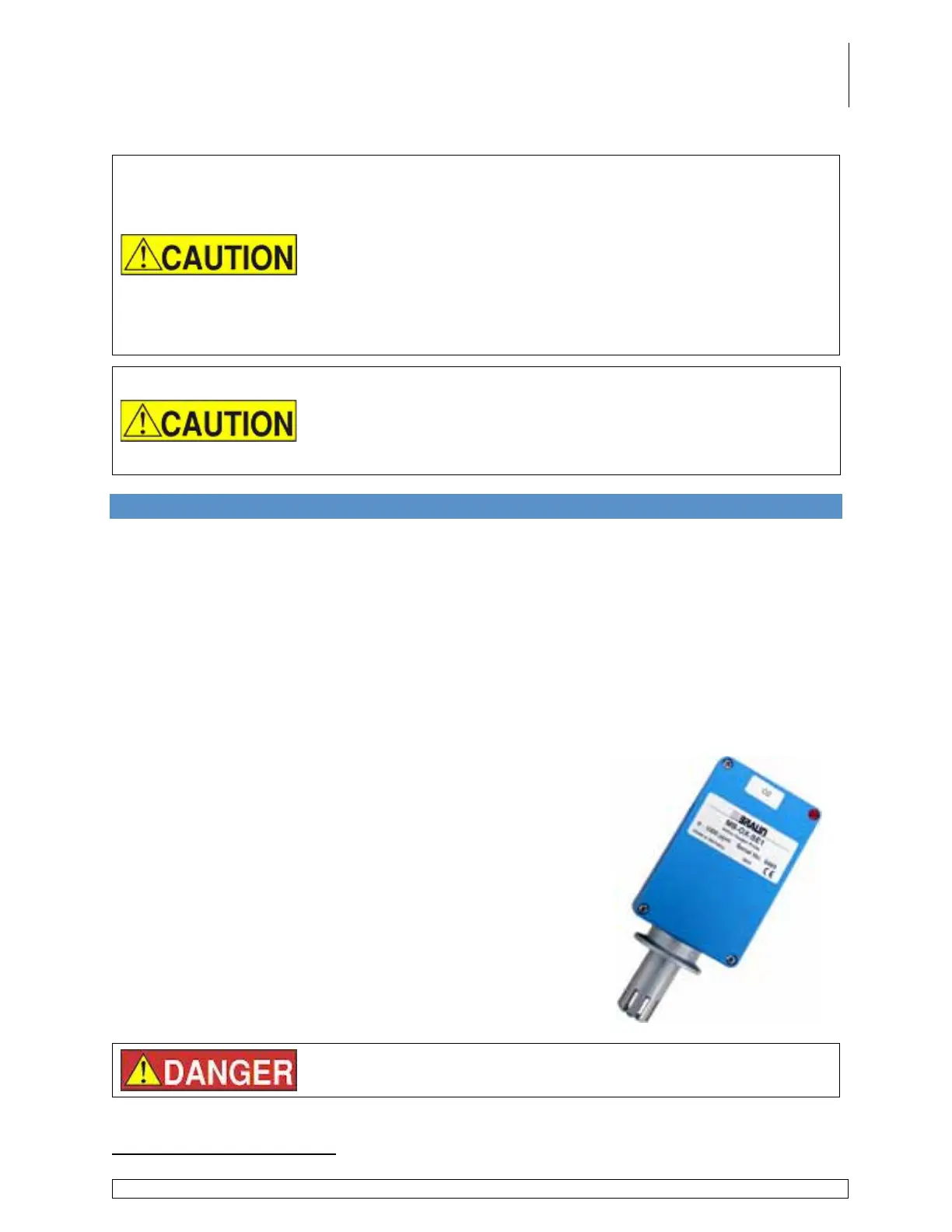
Oxygen Analyzer (MB OX-SE-1
©
)
The oxygen analyzer, with a measuring range of 0 –
1,000ppm, monitors the atmosphere inside the glovebox for
residual oxygen content. The analyzer is designed to provide
exact readings within the range of 0 – 100ppm. An estimated
reading of the oxygen content is provided when the oxygen
level rises above 100ppm.
The sensor element is a miniaturized Zirconium Dioxide plate
operated at elevated temperature that is controlled by a
platinum resistor. The electronics are supplied with 24 V DC
and deliver a 0 – 10V signal proportional to the concentration
of Oxygen. An additional input for the electronics allows the
switching on and off of the sensor heating by means of the
PLC.
1
Contact with Hydrogen, solvents and other aggressive gaseous
substances will cause permanent damage to the sensor.
1
M.Braun, Inc., Sales Literature, MB OX-SE1© Oxygen Probe, (Edition 2/2004)


 To Next Page