100 MDS iNET 900 User’s Guide MDS 05-2806A01, Rev. A
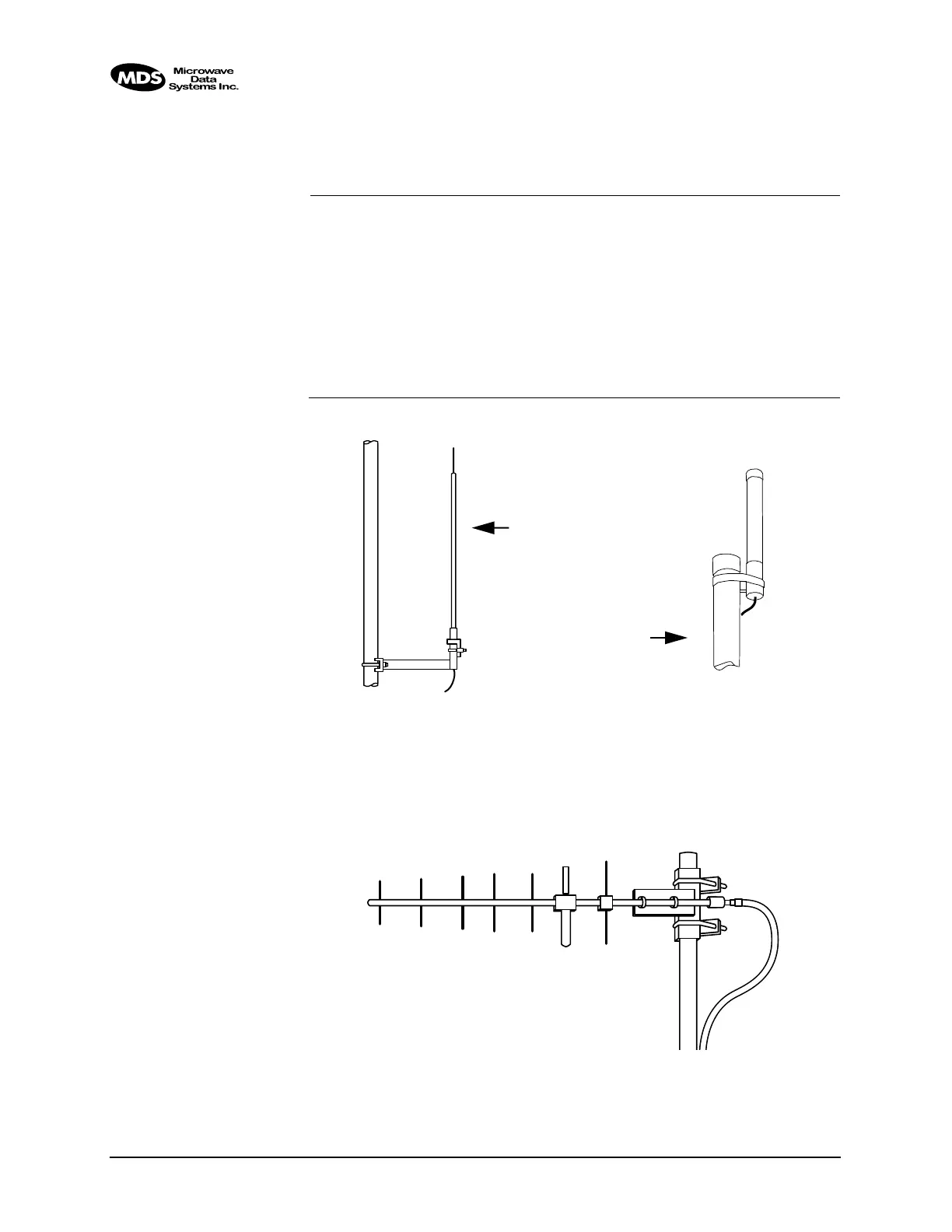
In general, an omnidirectional antenna (Figure 5-3) is used at the Access
Point station site. This provides equal coverage to all of the Remote
Gateway sites.
NOTE: Antenna polarization is important. If the wrong polarization is
used, a signal reduction of 20 dB or more will result. Most
systems using a gain-type omnidirectional antenna at the
Access Point station employ vertical polarization of the signal;
therefore, the remote antenna(s) must also be vertically polar-
ized (elements oriented perpendicular to the horizon).
When required, horizontally polarized omnidirectional
antennas are also available. Contact your MDS representative
for details.
Invisible place holder
Figure 5-3. Omnidirectional antennas for the MDS iNET 900
At Remote Gateway sites and units in point-to-point LANs, a directional
Yagi (Figure 5-4) antenna is generally recommended to minimize inter-
ference to and from other users. Antennas are available from a number
of manufacturers.
Invisible place holder
Figure 5-4. Typical Yagi antenna (mounted to mast)
High-gain Type
Unity-gain Type


 To Next Page