26/1531-ANF 901 14 Uen S 2019-10-18 28
C
ONFIGURING THE PHONE
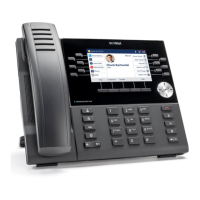
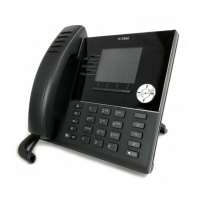
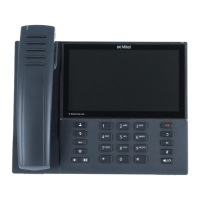
• Top Softkeys. In 6737/6757, 6867*, 6869* and in 6873.
• Programmable keys (hardkeys). In 6863, 6865*, 6730/31*, 6753*, 6735/55.
• Expansion module key, see section 14 Expansion Modules on page 58.
The softkeys are reserved in the following way:
• 1-4, system keys. For MX-ONE busy services (call back call pickup etc.) and for
xml kit applications. These are predefined as key type XML in
aastra.cfg/startup.cfg and will get the actual key label and value when busy
services is offered.
• 5, system key. Logon/Logoff is the first key visible in idle state.
• 6, system key. For Corporate Directory search (if this feature shall be used).
• 7, system key, For Diversion in 6739. In the other terminal models can softkey 7
be used for system key functions which shall be equal on all telephones in a
model, see 11.13.2 Default key layout on page 29.
• 8, system key to be defined by the system administrator, see 11.13.2 Default key
layout on page 29.
• 9 and upwards, individual keys for 6735/55,6737/57and 6739. The following
features are available and programmed form the PBX:
– BLF keys (MNS and DMN keys)
– Speed dial (TNS) key. Can also be programmed from a menu in the tele-
phone or from the web interface in the phone.
– Personal Number (PEN) key
– Shared Call Appearance (SCA) key
– Extra Directory Number (EDN) key
– Malicious Call Trace (MCT) key
The connection between the softkey number in the phone and the logical key
number when initiating a key in MX-ONE is: The logical key number 1 corre-
sponds to softkey number 9 in the phone, logical key 2 to softkey 10, etc.
The first available key number that can be used as an individual key is defined in
the configuration file in MX-ONE: /etc/opt/eri_sn/ip_telephony.conf
6900/6800 supports non-collapsed keys for top softkeys and softkeys, parameter:
collapsed softkey screen. The startup.cfg template is set to show top softkeys as
non-collapsed (fixed position; any keys of type none will be treated as empty). 6700
only supports collapsed topsoftkey and softkeys. This means that keys of type none are
not shown in the display. For example on a 6739i; if the softkey with key number 10 is
programmed with a speed dial number, the softkey will show up in the telephone
display on the first key position with type equal to none. If the user wants to have the
key on the phone display on the same position as where the key was programmed, the
softkeys in 6739i.cfg must be set to type empty with a matching setting in
/etc/opt/eri_sn/ip_telephony.conf, parameter: ExtensionKeyDefault:empty
The top softkeys and prgkeys on 6737/6757and 6735/55 are reserved for system
keys, see 11.13.2 Default key layout on page 29
The top softkeys on 6867/6920, 6869/6930 are reserved in the following way:
• 1, Diversion key, see 11.13.2 Default key layout on page 29.
•
2-n, individual keys of the type: mobile*, speeddial, xml, none, empty speeddialxfer, speeddial-
conf or phone lock (*not for 6920 phones).



 To Next Page