MP7505 Series User Manual
Pulse Width
PW is an abbreviation for pulse width and is divided into positive pulse width and
negative pulse width.
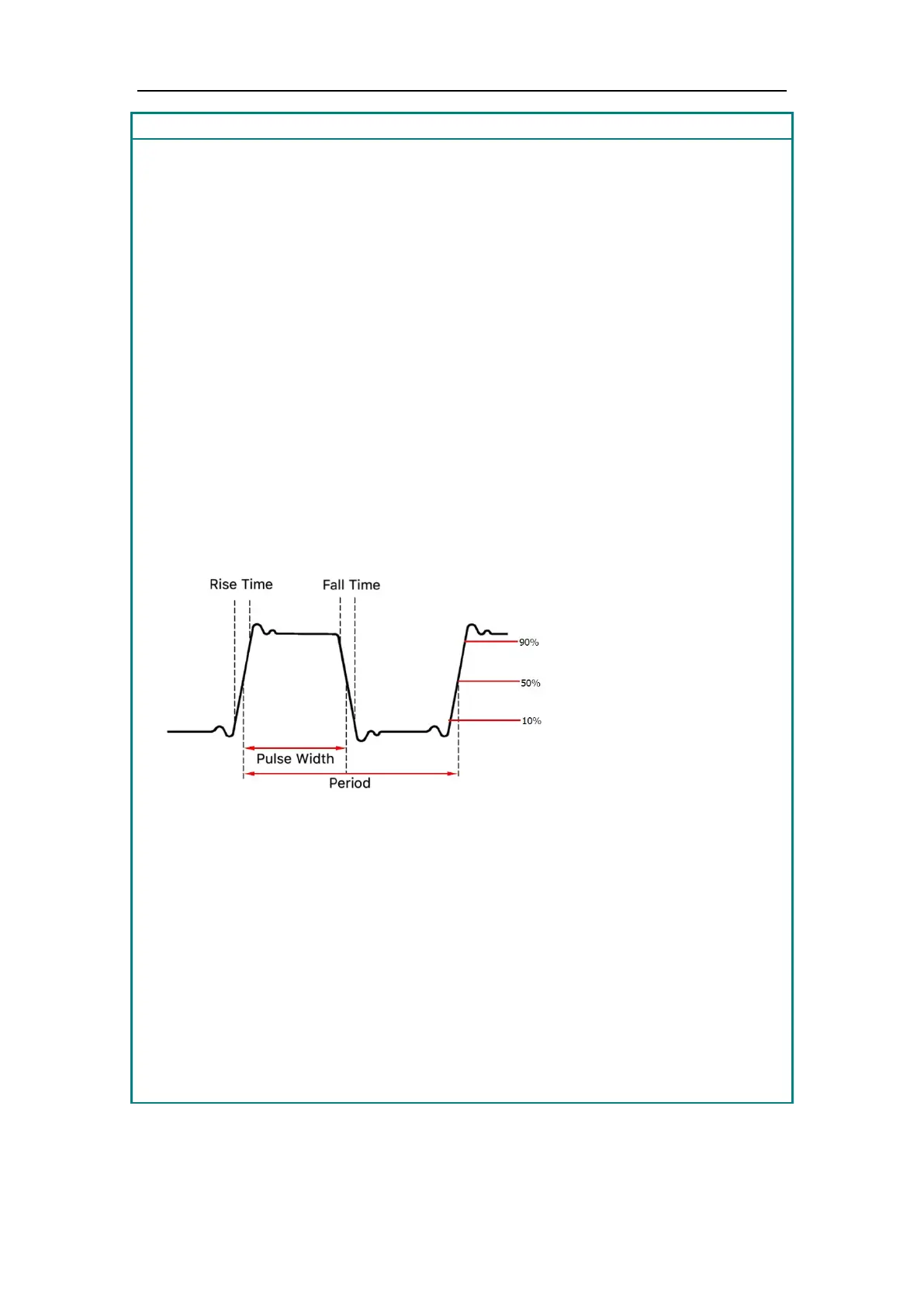
The positive pulse width is the time interval from 50% of the rising edge to 50% of
the adjacent falling edge.
The negative pulse width is the time interval from 50% of the falling edge to 50% of
the adjacent rising edge.
The pulse width is determined by the period and duty c
calculation formula is pulse width = period * duty cycle.
Duty Cycle
In a series of ideal pulse sequences (such as a square wave), the ratio of the duration
of the positive pulse to the total pulse period.
Pulse/Duty Cycle
The pulse
width is defined as the time interval from the 50% threshold of the
amplitude of the rising edge of the pulse to the 50% threshold of the amplitude of
the next falling edge, as shown in the following figure.
The settable range of pulse width is limited by the "minimum pulse width" and
"pulse period"
Pulse width ≥ minimum pulse width
Pulse width ≤ pulse period - minimum pulse width
The pulse duty cycle is defined as the pulse width as a percentage of the pulse
period.
The pulse duty cycle is associated with the pulse width, and modifying one of the
parameters will automatically modify the other parameter. The pulse duty cycle
is limited by the "minimum pulse width" and "pulse period".
Pulse duty cycle ≥ minimum pulse width ÷ pulse period × 100%
≤
(1 - 2 × minimum pulse width ÷ pulse period) × 100%


 To Next Page