Field Measurements 5:10
CP 1 – Cathodic Protection Tester Course Manual
© NACE International, 2000
02/01/05
Clamp-On Ammeters
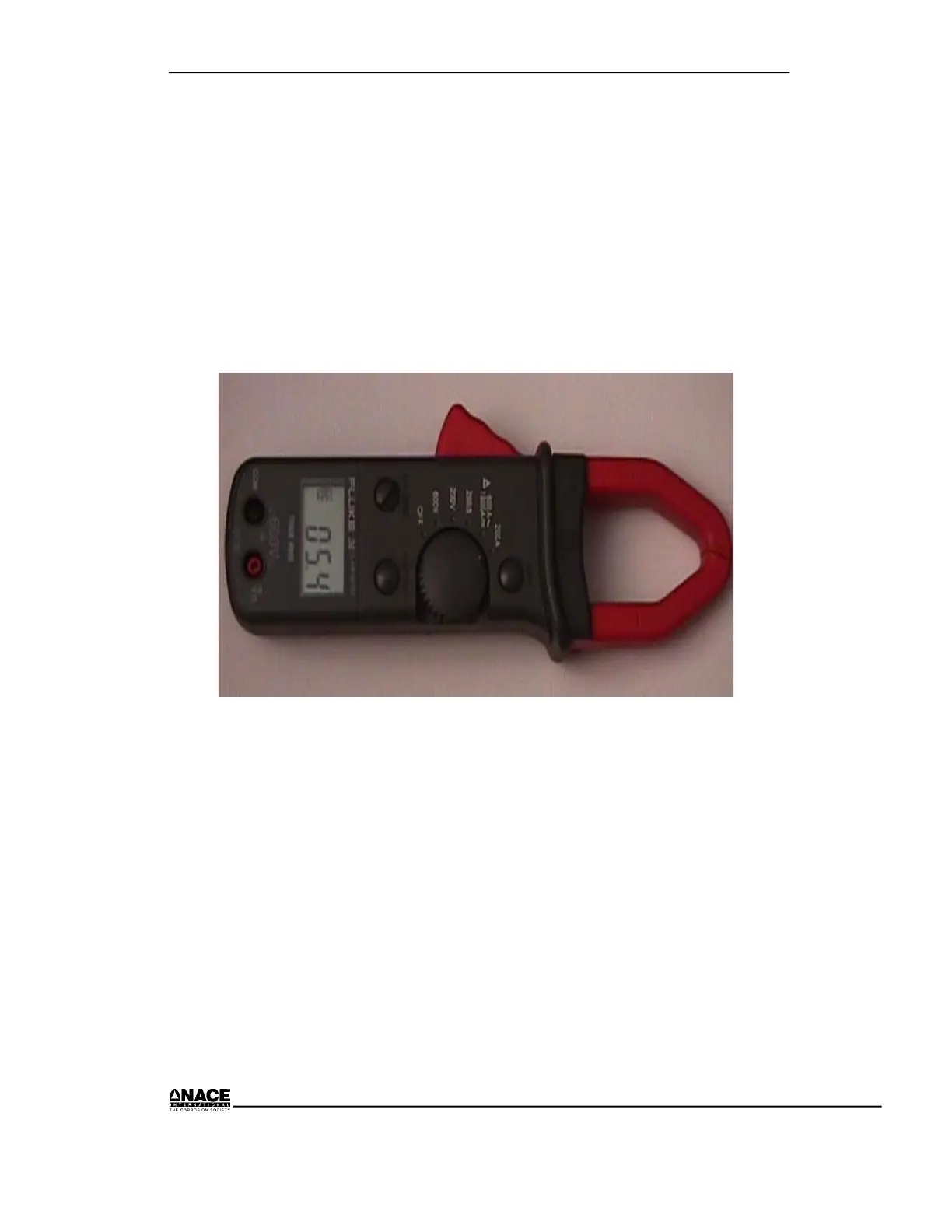
The second method of measuring current is with a clamp-on ammeter, (See
Figure 5.7). This device clamps around the metallic path through which the
current is flowing and measures the magnetic field created by the current.
Clamp-on instruments are available to measure both AC and DC.
Clamp-on ammeters are more commonly used for wires and cables than for
pipelines because of the high cost for large clamps and the meter associated
with those clamps. Clamp-on DC ammeters are available for pipes using
special sensing hoops.
Figure 5.7 Clamp-On Ammeter
Shunts
This is the third method of measuring current. In using a shunt, you
measure a voltage drop across a known resistance and calculate the current.
General
In practice, even the low internal resistance of an ammeter will affect
current flow in a galvanic anode system. Therefore, current shunts are
usually installed in the permanent circuit of a galvanic anode system,
although not in distributed anodes connected directly to the structure. In
fact, current shunts are favored over using an ammeter in most cases.



 To Next Page