Field Measurements 5:33
CP 1 – Cathodic Protection Tester Course Manual
© NACE International, 2000
02/01/05
Conductive
The conductive locator uses a radio frequency AC signal that is connected
to the structure by a direct wire.
The transmitter converts DC from dry cell batteries to AC by means of a
vibrator circuit. This AC can then be passed through a transformer to give
an output of several hundred volts, peak. This AC voltage is connected
between ground and the structure to be traced. The AC signal will then flow
through the earth to the structure and finally to the structure connection to
complete the circuit.
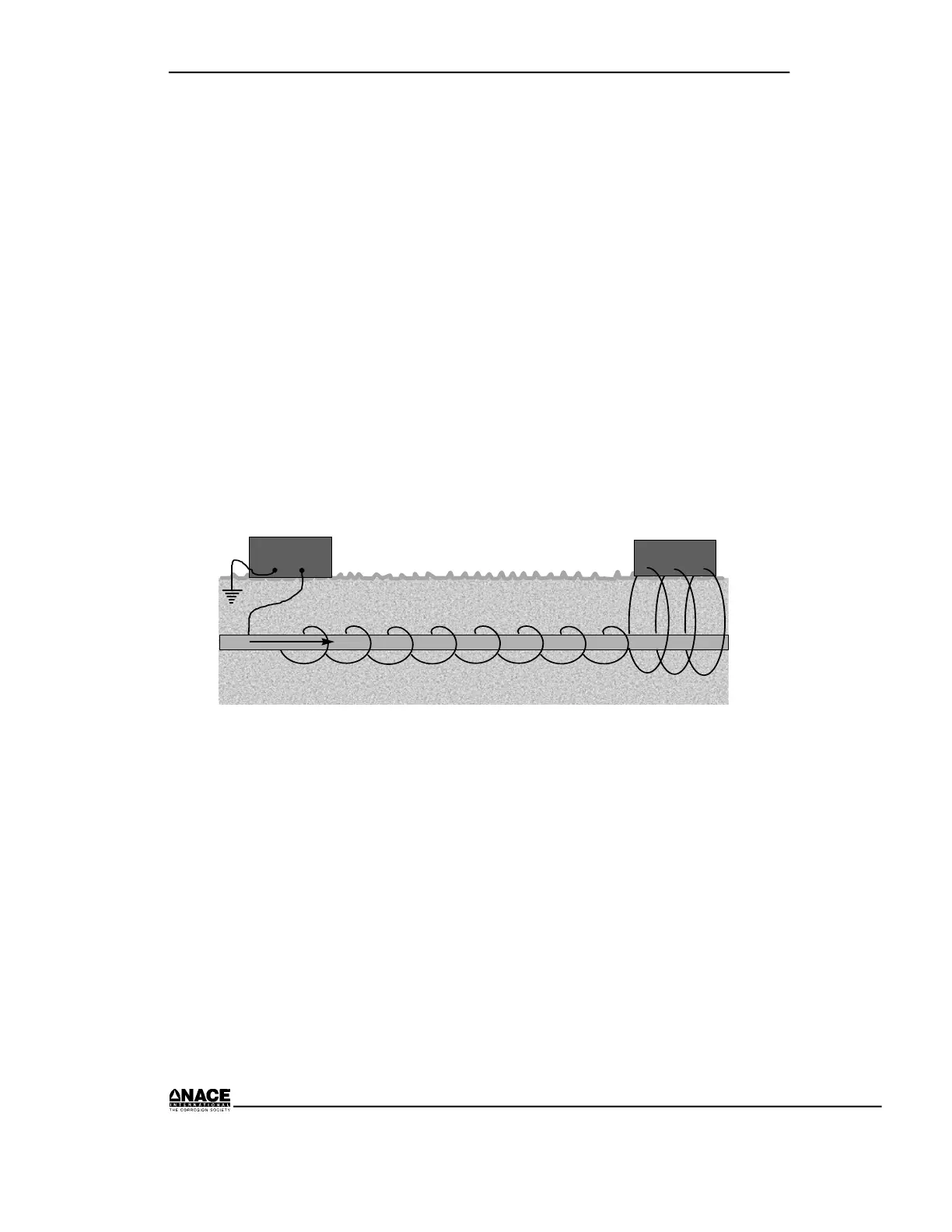
When the receiver is near the structure, the AC field around the structure
induces a voltage in the pickup coil. This voltage is amplified and produced
as an audible signal heard by the user.
Figure 5.16 illustrates the principle of the conductive locator.
Pipe
Transmitter
Receiver
Figure 5.16 Conductive Pipe Locator Principle
Figure 5.17 shows an example of a conductive locator.



 To Next Page