Basic Electricity 1:8
CP 1 – Cathodic Protection Tester Course Manual
© NACE International, 2000
02/01/05
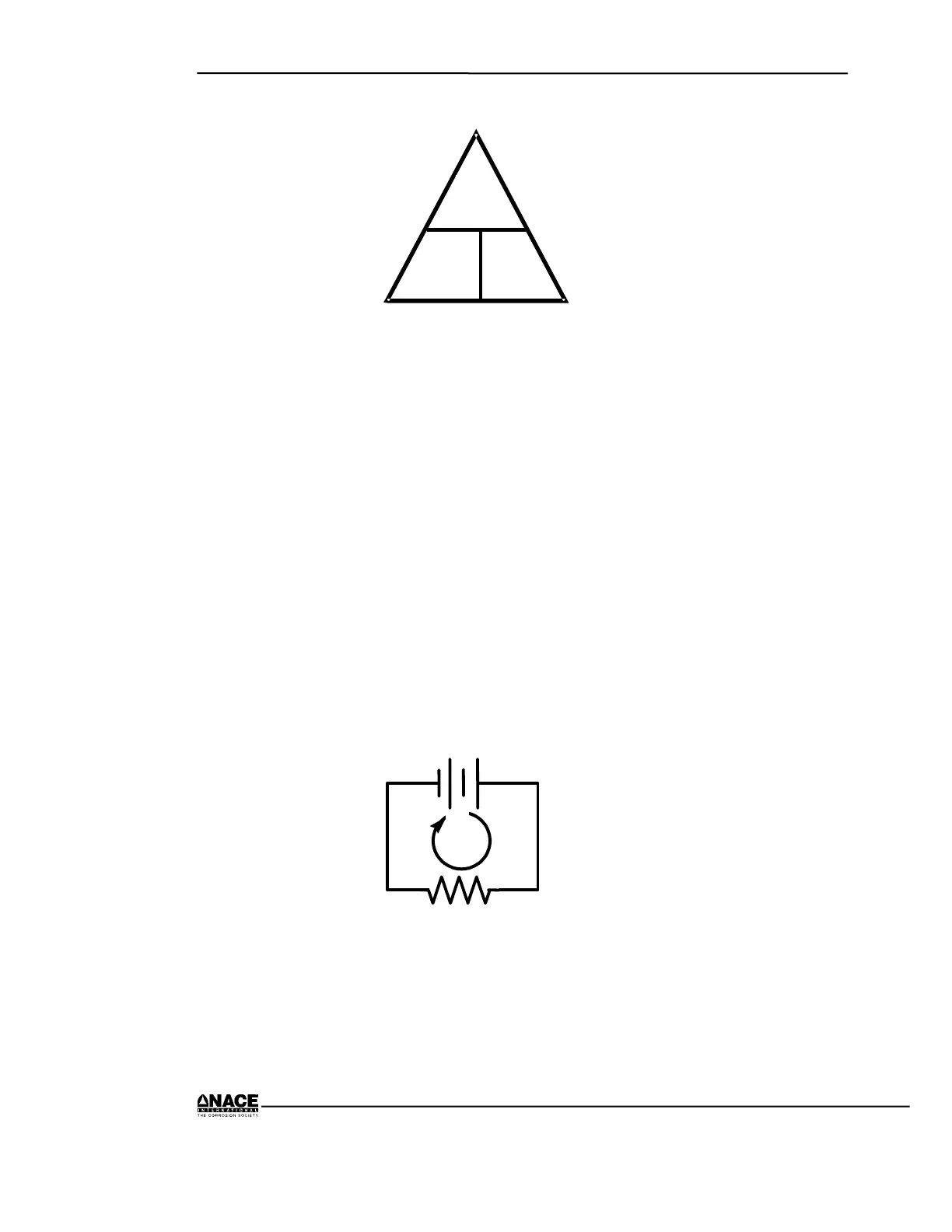
This can be graphically illustrated by the “Ohm’s Law Triangle”:
I
R
E
or
V
If two of the three variables are known, you can compute the third. If
you have measured the voltage and current in a cathodic protection
circuit, for example, you can easily calculate the circuit resistance.
An easy way to use the Ohm’s Law triangle is to place your thumb
over the quantity you are looking for. If you want to find resistance,
as in the above example, place your thumb over the R and you can
see that R = E/I. If you want voltage, placing the thumb over the E
shows you that E = I x R.
Note that the units used must be consistent: amperes, volts and
Ohms. Amperes and millivolts or volts and milliamps cannot be
mixed.
Consider the circuit in Figure 1.3. A battery is connected across a
known resistance.
+
E=1 volt
R=1000 Ohms
I
Figure 1.3 Current Through a Resistor



 To Next Page