Basic Electricity 1:10
CP 1 – Cathodic Protection Tester Course Manual
© NACE International, 2000
02/01/05
Kirchhoff’s Laws
Voltage Law
This law states that the sum of the source voltages around any closed
loop of a circuit is equal to the sum of the voltage drops across the
resistances in that loop.
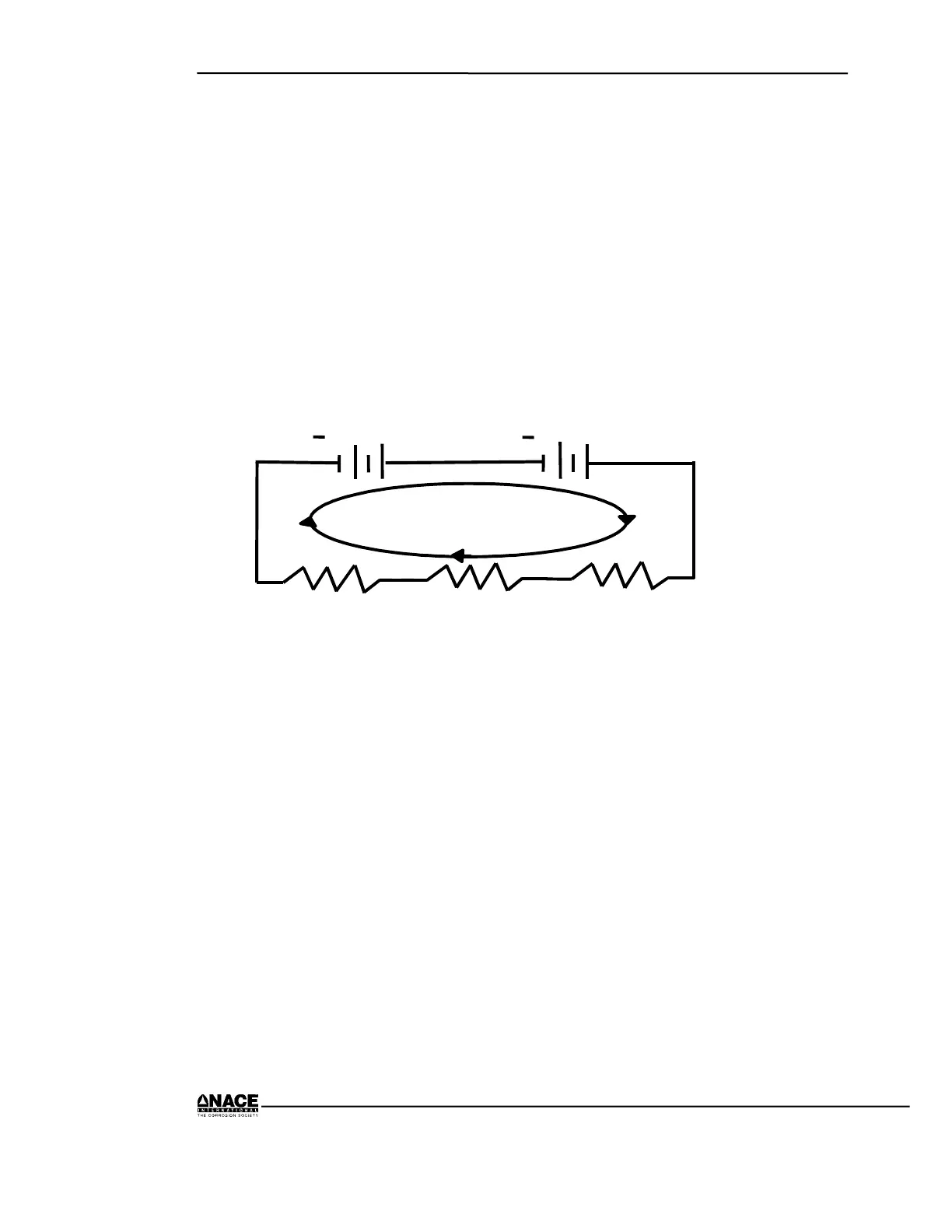
For example, in Figure 1.4:
Source voltages = 12V + 12V = 24V = IR drops (
8V + 8V + 8V)
E
= 12 V
= 8 V
I
E
= 12 V
= 8 V
= 8 V
++
Figure 1.4 Kirchhoff’s Voltage Law
The driving voltage in this circuit is a 24-volt battery. The voltage (I
x R or IR) drop across each resistor is 8 volts. In this example, the
three resistors are the same size. If the resistors were of different
sizes, the sum of the voltage drops across them would still equal 24
volts. Voltage drops in an electrical circuit are like pressure drops
along a length of pipeline. If the various pressure drops are added
up, they will equal the total pressure drop across that length of
pipeline.
Current Law
This law states that as much current flows away from a point as
flows toward it. It is especially useful in analyzing parallel circuits
and in tracing current flow in complex piping networks.



 To Next Page