Troubleshooting 9:4
CP 1 – Cathodic Protection Tester Course Manual
© NACE International, 2000
07/01/04
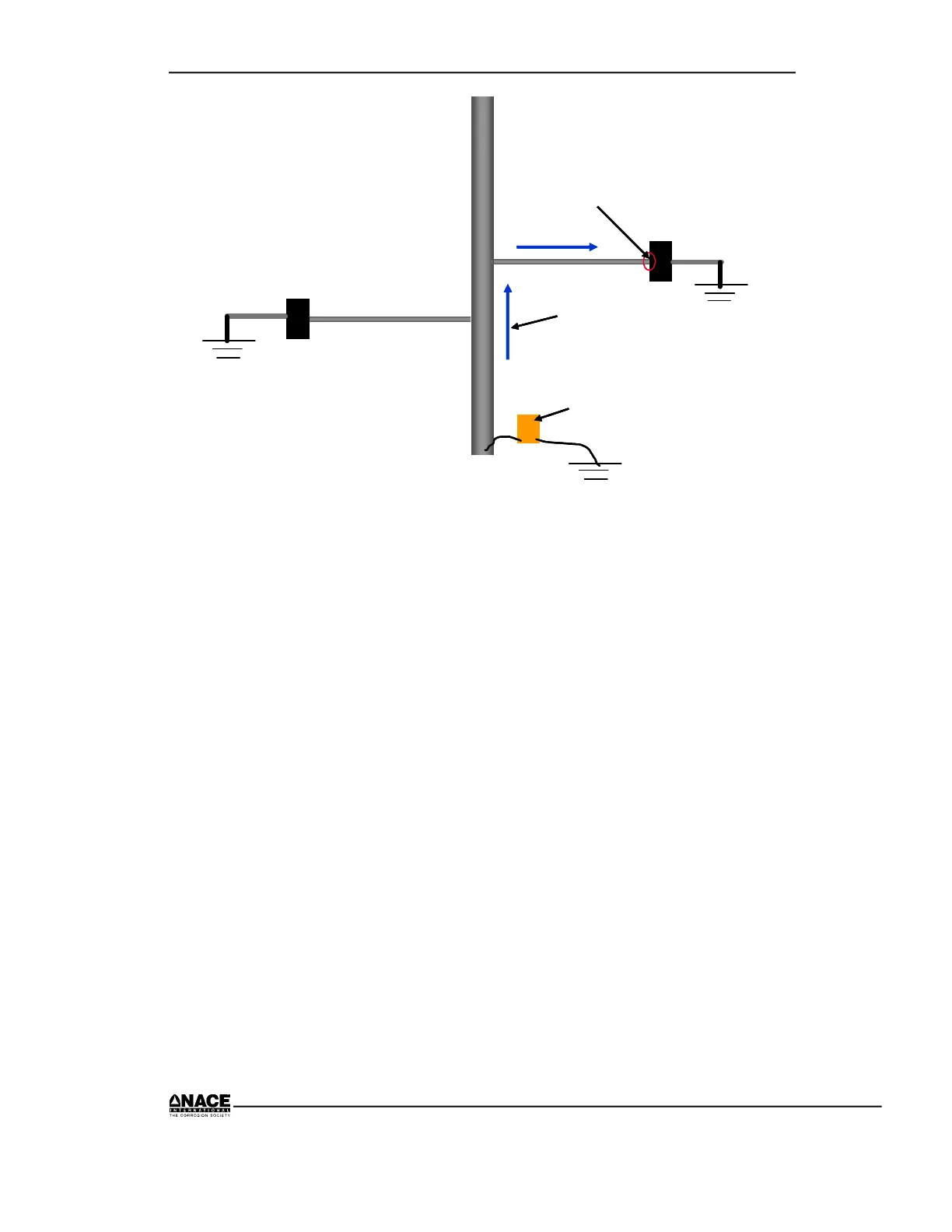
Short
Tone Generator
Signal Path
Short
Tone Generator
Signal Path
Figure 9.3 Using Audio Tone Locator to Find Shorts
Casing Shorts
Casings must be electrically isolated from the carrier pipe. This is necessary
to prevent the casing from picking up cathodic protection current and thus
reducing the effectiveness of protection on the pipeline. Isolation is also
necessary to allow cathodic protection to reach the carrier pipe within the
casing if there is water or other electrolyte inside the casing.
A simple way of testing for a short is to measure the pipe-to-soil potential
of both the casing and the pipeline. This requires wires on both the pipeline
and the casing. If there are no wires on the casing, the vent can be used
instead.
There should be difference of anywhere from about 0.250 volt to 1.000 volt
or more between the pipe-to-soil potentials of the casing and the pipeline. If
the casing has anodes connected to it, the difference may be smaller. In that
case, current pick-up or resistance tests between the casing and the pipeline
may be required.
A current pick-up test is run by applying a cathodic protection current to
the pipeline and measuring the resultant shift in pipe-to-soil potential. If the
same potential shift occurs on the casing, a short exists.



 To Next Page