Page 4-4 V10/V7.5/V5/V3.5 Installation and Operation Manual
Issue 3.5 Section 4 Testing and Adjustment
4.3.4 Transmitter Turn-On
NOTE
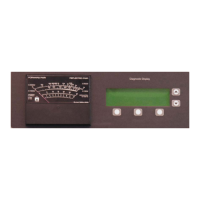
Monitor the GUI’s main screen during initial
turn-on. Monitor forward power on the
analog meter or on the transmitter status
bar at the top of the GUI.
If the text associated with the GUI’s centre
soft-key changes from blank to Status, a
fault has occurred. Discontinue adjustment
of the transmitter and press the Status
button to determine the nature of the fault.
(a) Verify the requirements of paragraph
4.3.3 have been completed.
(b) Turn on the transmitter using the Initial
Turn On procedure (see 2.4.3).
(c) Ensure the Tot. PA Current indication
on the GUI, representative of the
current drawn by the RF power
modules, is within ± 5% of the level
recorded as Total PA Current in the
Critical Parameters sheet.
(d) The Refld Pwr (reflected power) on
the GUI will be less than 63 W (V10),
57 W (V7.5), 23 W (V5) or 16 W
(V3.5). Using the Ext Meter &
Contrast menu (see 3.6.10), check the
Refld Power (should be approximately
the same as the GUI reading) and Fwd
Power (should be near the preset
power level) indications on the analog
meter.
NOTE
Paragraphs 4.3.5 through 4.3.5.8 reference
rated, minimum and maximum operating
power levels for the transmitter. Use Table
1-1 to determine the power levels for a
specific mode and transmitter.
4.3.5 Remote Control Checks
4.3.5.1 Remote Control Prerequisites
Complete the following for each check,
excluding the NxLink check in 4.3.5.10:
(a) On the front panel, verify the lamp in
the Control - Local switch is on,
indicating local control is selected.
(b) Select exciter ‘A’, IPA ‘A’ (module for
V10/V7.5, PA for V5/V3.5), IPA PS ‘A’
(ganged with IPA module for V10/V7.5,
independent for V5/V3.5) and fan
supply ‘A’ from the GUI’s changeover
menu (see 3.6.13).
(c) Select the preset that will yield the
transmitter’s rated RF output power
(see 3.6.4).
(d) Select remote control. Press Control -
Remote switch, noting its integral lamp
turns on and the Control - Local
switch's lamp turns off. All other status
lamps will remain the same.
(e) The remote interface PWB's remote
status pin (J4-22) and XMTR READY
STATUS terminal (TB1-13) will be
current-sink-to-ground. The SMY
ALARM terminal (TB1-4) will be an
open-collector.
NOTE
The remote interface PWB (A44) has a
positive (+) and a negative (-) terminal for
each control input function. Each control
circuit can be configured to accommodate
a single ended or differential input. See
Table 3-6.
4.3.5.2 Remote On/Off Control
Verify the transmitter's on/off function can
be controlled from a remote location as
follows:
(a) Verify 4.3.5.1 is complete.


 To Next Page