75
2. Similarly, insert your Allen key in the tethering hole at the top of the plate holder and rotate it in
the vertical plane while checking the delivered power; stop when you reach a maximum.
3. Tighten the top and bottom locking screws back in position.
8-4 Modulation in details
This chapter will provide detailed information about the regulation loops, power tuning and the modulation
functions.
THE POWER REGULATION LOOPS
The LaserBoxx laser sources operate by releasing an optical signal against a given set point. Two different
control methods exist to regulate the optical signal.
AUTOMATIC CURRENT CONTROL
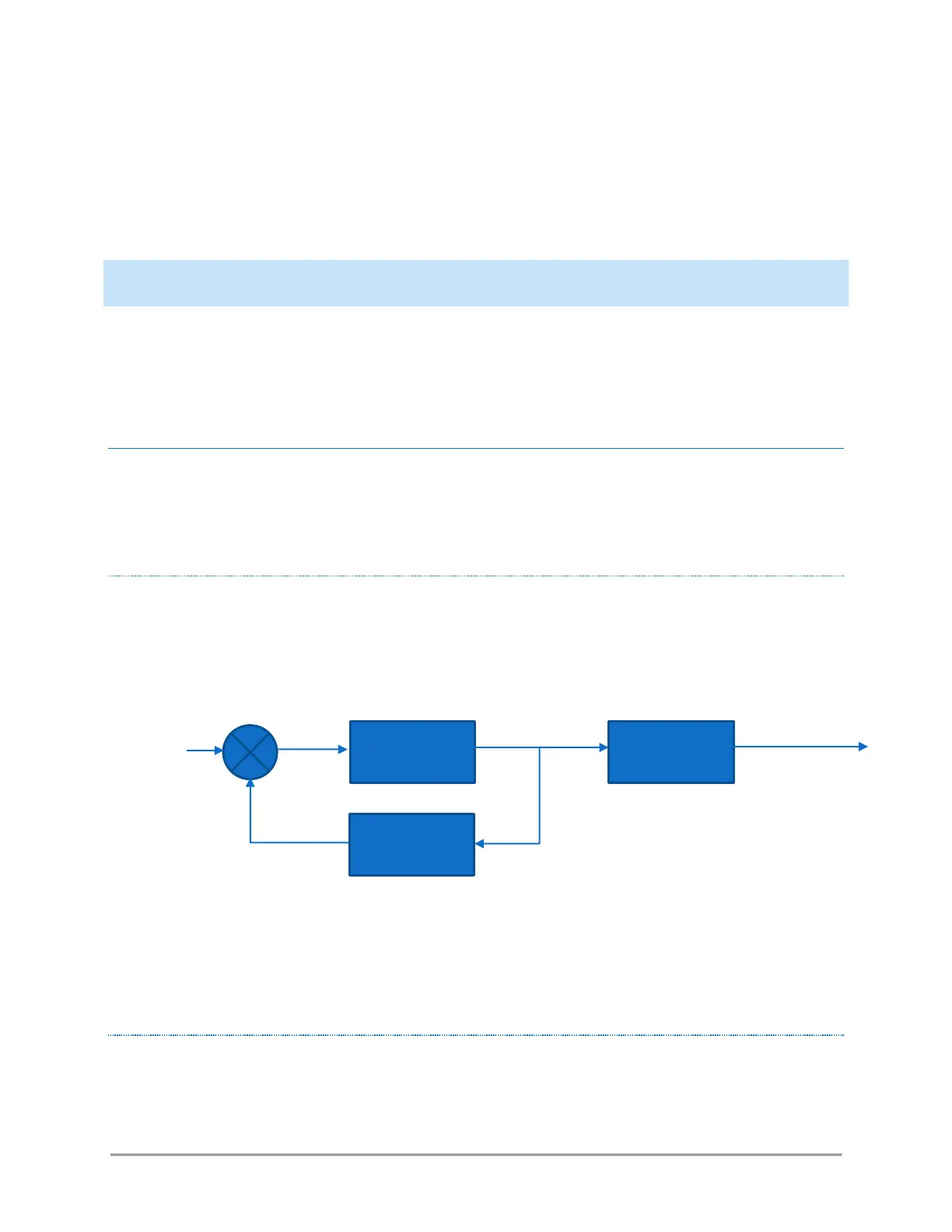
Using this control loop, the user sets a pump current that will drive the laser diode. The control loop consists
in acting so that the actual current is equal to the user-defined set-point.
Here is its block diagram:
This loop allows for a tight control over both the current and the temperature of the laser diode, and is
therefore advisable in applications where, for example, a good wavelength stability is required.
Note that the ACC loop is unavailable on the LCX laser sources.
AUTOMATIC POWER CONTROL
Using this control loop, the user sets the optical power to be released by the laser head. The control loop
consists in acting so that the actual power is equal to the user-defined set-point.



 To Next Page