
 Need help?
Do you have a question about the Planet SGSW-24040 and is the answer not in the manual?
Details the items included in the product package for verification upon unboxing.
Provides an overview of the product's features, capabilities, and benefits for SMBs and enterprises.
Explains the manual's structure and how to navigate through its sections for effective use.
Details the physical ports, layer 2 features, quality of service, security, and management capabilities.
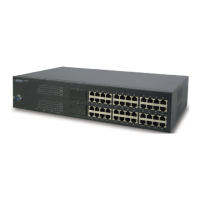
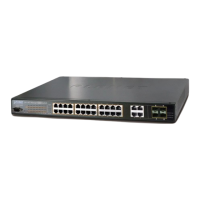
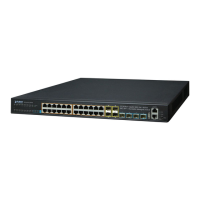
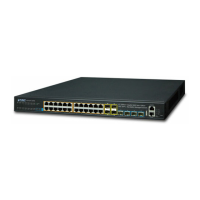
Lists the detailed hardware specifications for various models including ports, fabric, address table, and dimensions.
Describes the physical components and interfaces of the switch, including front and rear panels.
Provides step-by-step instructions for installing the switch, including desktop and rack mounting.
Details the process of connecting multiple switches in a stack for unified management.
Lists the necessary hardware and software prerequisites for managing the switch.
Compares the advantages and disadvantages of Console, Web Browser, and SNMP Agent management methods.
Explains how to access and use the character-oriented command-line interface for system administration.
Describes how to manage the switch using a web browser interface via its IP address.
Explains how to configure and manage the switch using external SNMP applications.
Provides an overview of the main web interface, including panel display and main functions menu.
Covers basic administrative details, including system information, IP/IPv6 configuration, and user management.
Explains the SNMP protocol, its components, operations, and community settings.
Covers viewing and configuring port settings like speed, duplex, flow control, and power.
Details port aggregation techniques to optimize port usage and increase bandwidth and redundancy.
Explains Virtual Local Area Networks (VLANs), their benefits for performance and security.
Explains the Spanning Tree Protocol's function in detecting and disabling network loops and providing backup links.
Covers IGMP snooping for monitoring IGMP messages and limiting multicast frames to member ports.
Explains Quality of Service (QoS) as a traffic prioritization feature for controlling network traffic.
Details configuration of Access Control Lists (ACLs) by defining ACEs for traffic filtering.
Covers controlling access via IEEE 802.1X, MAC-based authentication, and user authentication.
Details security features like Port Limit Control, Access Management, DHCP Snooping, and ARP Inspection.
Explains the MAC address table and its configuration for static and dynamic entries.
Explains Link Layer Discovery Protocol (LLDP) for discovering neighboring devices and LLDP-MED extensions.
Provides tools for Physical and IP layer network diagnostics, including Ping and Cable Diagnostics.
Provides an overview of Power over Ethernet technology and its configuration.
Details how to connect multiple switches in a stack for unified management and operation.
Explains how to access the Command Line Interface (CLI) via console or Telnet connection.
Details the process of logging into the switch via the console port using default credentials.
Explains how to check and configure the switch's IP address, subnet mask, and gateway.
Describes how to log in remotely for management using the Telnet protocol.
Categorizes CLI commands into groups based on functionality, such as System, Stack, and IP.
Covers system-related commands for configuration, reboot, restore defaults, and logging.
Provides information on stacking architecture, including Switch IDs, Master Election, and Stack Redundancy.
Covers IP configuration, DHCP client settings, IP setup, ping, and DNS server configuration.
Covers viewing and configuring port settings like speed, duplex, flow control, and power.
Details configuration of MAC address table entries, including adding, deleting, and lookup.
Explains VLAN configuration, including PVID, frame types, modes, and membership settings.
Covers configuration of Private VLANs, including isolation and membership settings.
Details security configurations for user management, authentication, SNMP, and access control.
Covers STP configuration, bridge settings, MSTI priorities, and port configurations.
Explains IGMP snooping configuration, port settings, and VLAN configuration for multicast.
Covers link aggregation configuration, including static LAGs and LACP settings.
Details LACP configuration, mode, key, role, status, and statistics.
Covers LLDP configuration, mode, optional TLVs, interval, hold, delay, and statistics.
Allows configuration of LLDP-MED settings, including coordinates, civic address, and policies.
Covers PoE configuration, mode, priority, power limits, and status.
Details QoS configuration, including classes, QCL, port QoS, bandwidth control, and storm control.
Configures port mirroring to monitor network traffic by copying packets to a specific port.
Allows saving and loading switch configuration to and from a TFTP server.
Covers loading new firmware to the switch via TFTP server.
Configures UPnP settings, including mode, TTL, and advertising duration.
Configures Multicast VLAN Registration (MVR) for sharing multicast traffic across VLANs.
Enables voice traffic forwarding on a Voice VLAN, allowing classification and scheduling.
Covers SMTP configuration, mode, server settings, and authentication.
Provides commands to display the configuration status of various features like ACL, IP, and VLAN.
Explains the address table used for storing MAC address information and port mapping.
Describes how the switch records source addresses and port numbers for future packet decisions.
Details how the switch checks destination addresses and forwards or filters packets based on the address table.
Explains the Store-and-Forward packet-forwarding technique for efficient and stable network operation.
Describes the Auto-negotiation technology for automatically setting the best bandwidth and duplex mode.
Explains Power over Ethernet (PoE) technology based on IEEE 802.3af for delivering power over data cables.
Describes the two main devices in a PoE system: the Powered Source Equipment (PSE) and the Powered Device (PD).
Explains how power is transferred through standard CAT5 Ethernet cables using spare or data pairs.
Details the process of adding PoE support, including preparation and PSE responsibilities.
Provides solutions for issues where the Link LED is not lit on the Ethernet Switch.
Offers troubleshooting steps for connectivity issues between stations on different ports.
Suggests checks for duplex status and port I/O rates to diagnose poor performance.
Provides steps to troubleshoot network connectivity issues, including checking LEDs and cables.
Offers solutions for issues where the switch fails to power up, checking AC power and connections.
Details the RJ-45 pin assignments for 1000Mbps, 1000Base T connections.
Provides RJ-45 connector pin assignments for 10/100Mbps Ethernet connections.
Access Control Entry: Describes access permission associated with a particular ACE ID.
Access Control List: A list of ACEs specifying individual users or groups permitted or denied traffic.
Address Resolution Protocol: Converts an IP address into a physical address for network communication.
Dynamic Host Configuration Protocol: Assigns dynamic IP addresses and other parameters to network devices.
Link Layer Discovery Protocol: Advertises system capabilities and management addresses on an IEEE 802 LAN.
Maps MAC addresses to switch ports for knowing where to forward frames based on DMAC address.
Quality of Service: Guarantees bandwidth relationship between applications or protocols for predictable service.
Virtual LAN: Restricts communication between switch ports and creates separate broadcast domains.
 General
| Type | Managed |
|---|---|
| Switching Capacity | 48 Gbps |
| Throughput | 35.7 Mpps |
| MAC Address Table | 8K |
| Uplink Ports | 4 x 100/1000BASE-X SFP |
| Jumbo Frame | 9K bytes |
| Power Supply | 100-240V AC, 50/60Hz |
| Dimensions (W x D x H) | 440 x 200 x 44 mm |
| Ports | 24 x GE RJ45 |




 To Next Page
