4.5 PRESSURE PLATE UP/DOWN MECHANISM VT2300/2500
[0]
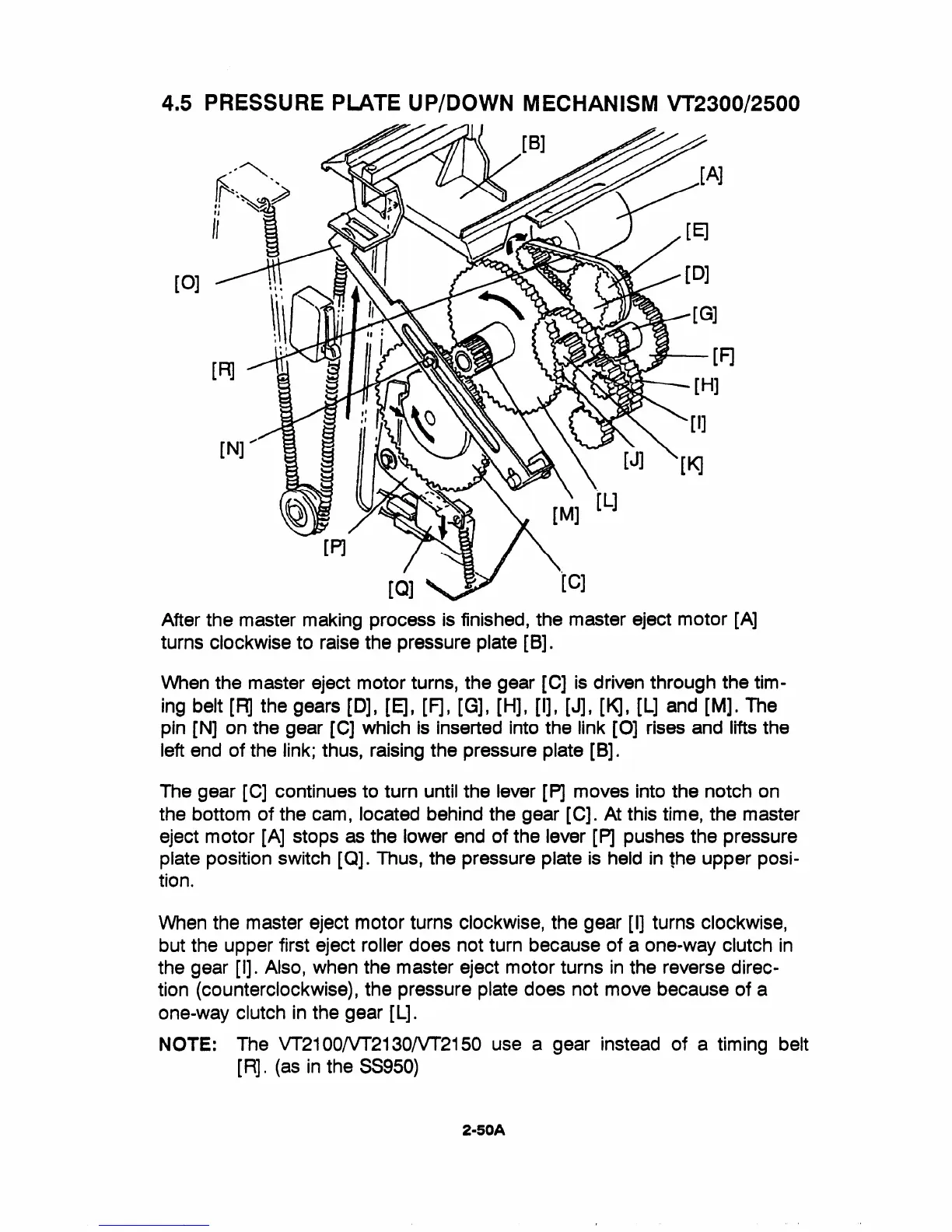
After the master making process is finished, the master eject motor [A]
turns clockwise to raise the pressure plate [B].
When the master eject motor turns, the gear [C] is driven through the tim-
ing belt [Rl the gears [D], [~, [Fl, [G], [H], [1], [J], [KJ, [L] and [M]. The
pin [N] on the gear [C] which is inserted into the link [0] rises and lifts the
left end of the link; thus, raising the pressure plate [B].
The gear [C] continues to turn until the lever [Pl moves into the notch on
the bottom of the cam, located behind the gear [C]. At this time, the master
eject motor [A] stops as the lower end of the lever [Pl pushes the pressure
plate position switch [Q]. Thus, the pressure plate is held in the upper posi-
tion.
When the master eject motor turns clockwise, the gear [1] turns clockwise,
but the upper first eject roller does not turn because of a one-way clutch in
the gear [1]. Also, when the master eject motor turns in the reverse direc-
tion (counterclockwise), the pressure plate does not move because of a
one-way clutch in the gear [L].
NOTE: The VT2100/VT2130/W2150 use a gear instead of a timing belt
[R]. (as in the SS950)
2-50A


 To Next Page