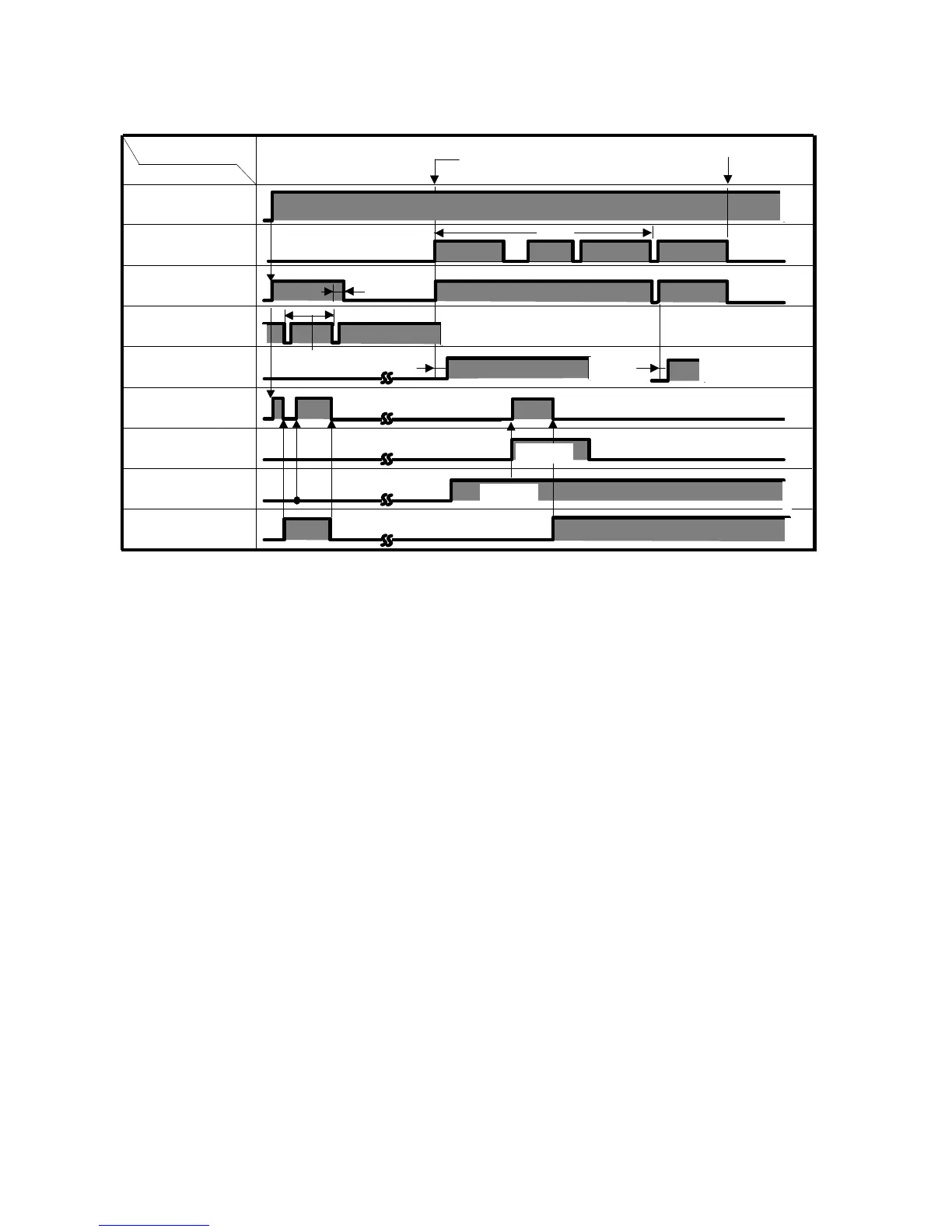
2.3.10 Timing chart
Operation before the copy stand-by
Description
❈1 The OPC home mark is detected twice to determine the length of one belt cycle, counting the
number of clock pulses of the OPC motor encoder from the first detection to another.
The segments are equally divided according to size, and each segment position is also
determined by this pulse count.
❈2. Turning the tracking motor on for the first time detects the sector sensor.
❈3. The sector sensor also identifies the tilt direction of the tracking rollers. Therefore, if the
signal from the edge R or F does not meet the direction for offset correction, the tracking motor is
turned ON again to reverse the offset correction direction.
❈4. When the fusing temperature reaches 175°C, the OPC motor starts turning, then stops (OPC
idling mode). During this period, the main motor repeats turning on and off three times. The first
rotation is to feed out any sheets in the paper path of the machine if there are any. If some sheets
of paper remain on the paper path, this feeds out the paper. The second rotation is to measure V0
(basic OPC potential) to do the OPC rest time compensation. The third is to measure VR (OPC
residual potential). After that, the main and OPC motors turn on and off once more to make and
measure the ID sensor pattern. Then, the machine enters the copy stand-by mode.
Timing
Item
Main switch
Main motor
OPC motor
OPC mark sensor
Quenching lamp
Tracking motor
Rear edge sensor
Front edge sensor
Sector sensor
L
H
L
L
H
H
H
0.7 sec0.7 sec
0.2 sec
ID sensor mode
Copy stand-by
Shield
OPC idling mode
Shield
175 ° (Fusing temperature)
1 OPC belt rotation
❈4
❈2
❈3
❈1



 To Next Page