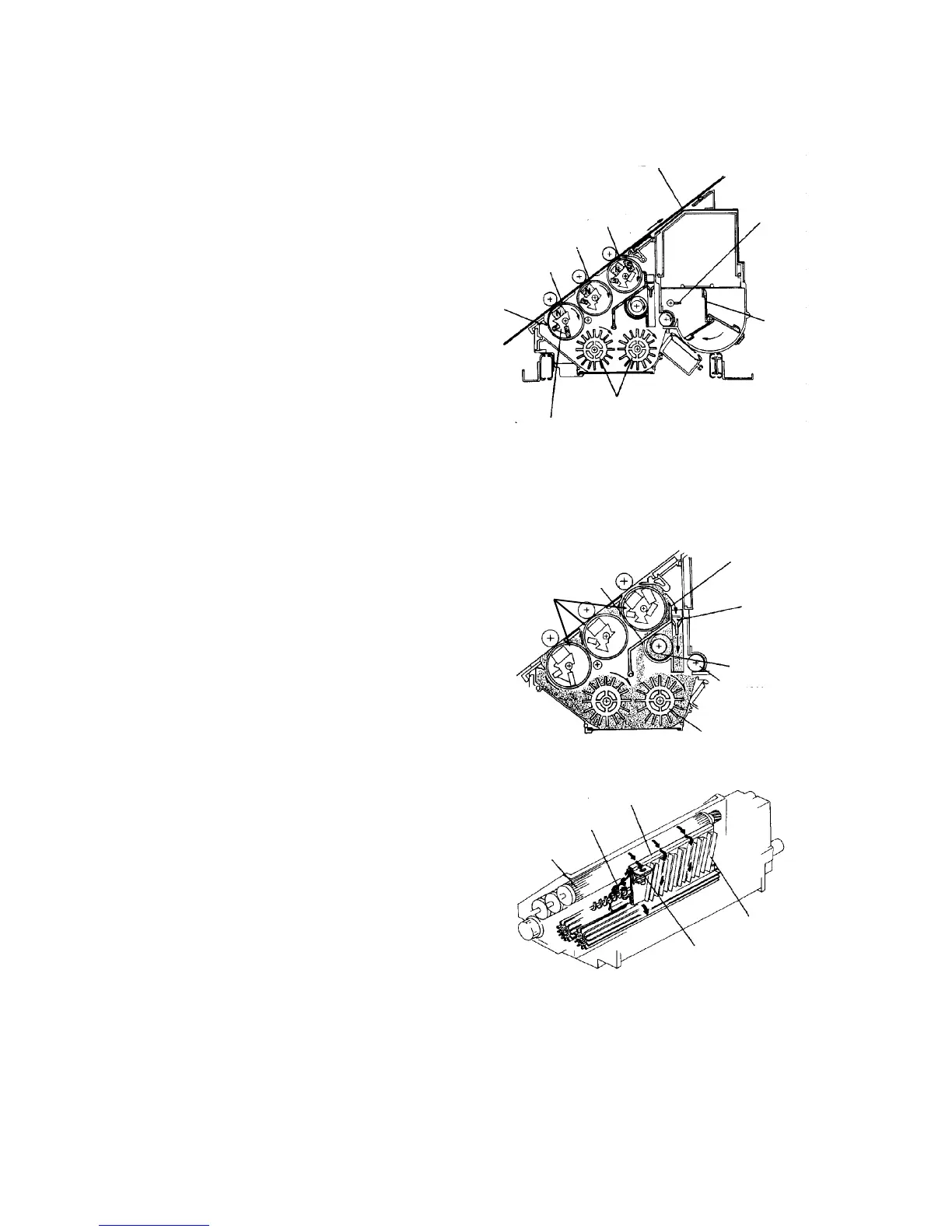
2.9.2 Development mechanism
Three development rollers are used for high-speed
development. The developer from the paddle wheel is
regulated at a fixed height by the doctor blade and
transported from the 1st roller to the 2nd roller and on to
the 3rd roller. When the developer contacts the
photoconductor, the toner in the developer is attracted to
the OPC according to the charge distribution on the
OPC surface.
The magnet holder is fixed and the main pole angle
cannot be adjusted. The development roller is arranged
parallel to the direction of photoconductor movement,
and it rotates in forward to equalize black density and to
guard against dirty background.
The developer employed is spherical. A resin coat
applied to the developer increases its durability and
results in a stable image. The sphere diameter is 100µ.
4 kg of developer is required per machine.
Because the photoconductor is charged negatively, and
the toner is friction charged positively, negative potential
is applied for the development bias.
2.9.3 Developer agitator mechanism
The developer fed to the 3rd roller is scraped off by the
separator. The center part of the scraped developer
passes through the toner density sensor to detect the
density of the toner. The remaining toner is transported
to the backspill plate and falls onto the paddle wheels
evenly.
The developer is transported from front to rear by the
rotation of the transport auger, from rear to front by the
separator fins located on the separator.
NOTE
The peripheral velocity of the development roller is
689.67 mm/sec. (1.6 times higher than the speed
of the OPC.)
Photoconductor
Small toner agitator
Main toner
Paddle wheel
Magnet holder
Doctor blade
1st roller
2nd roller
3rd roller
Backspill
plate
Separator
Toner
density
sensor
Developer auger
Toner supply roller
Fin
Toner density sensor
Separator
Casing
3rd development
roller
Paddle wheel
Development
rollers



 To Next Page