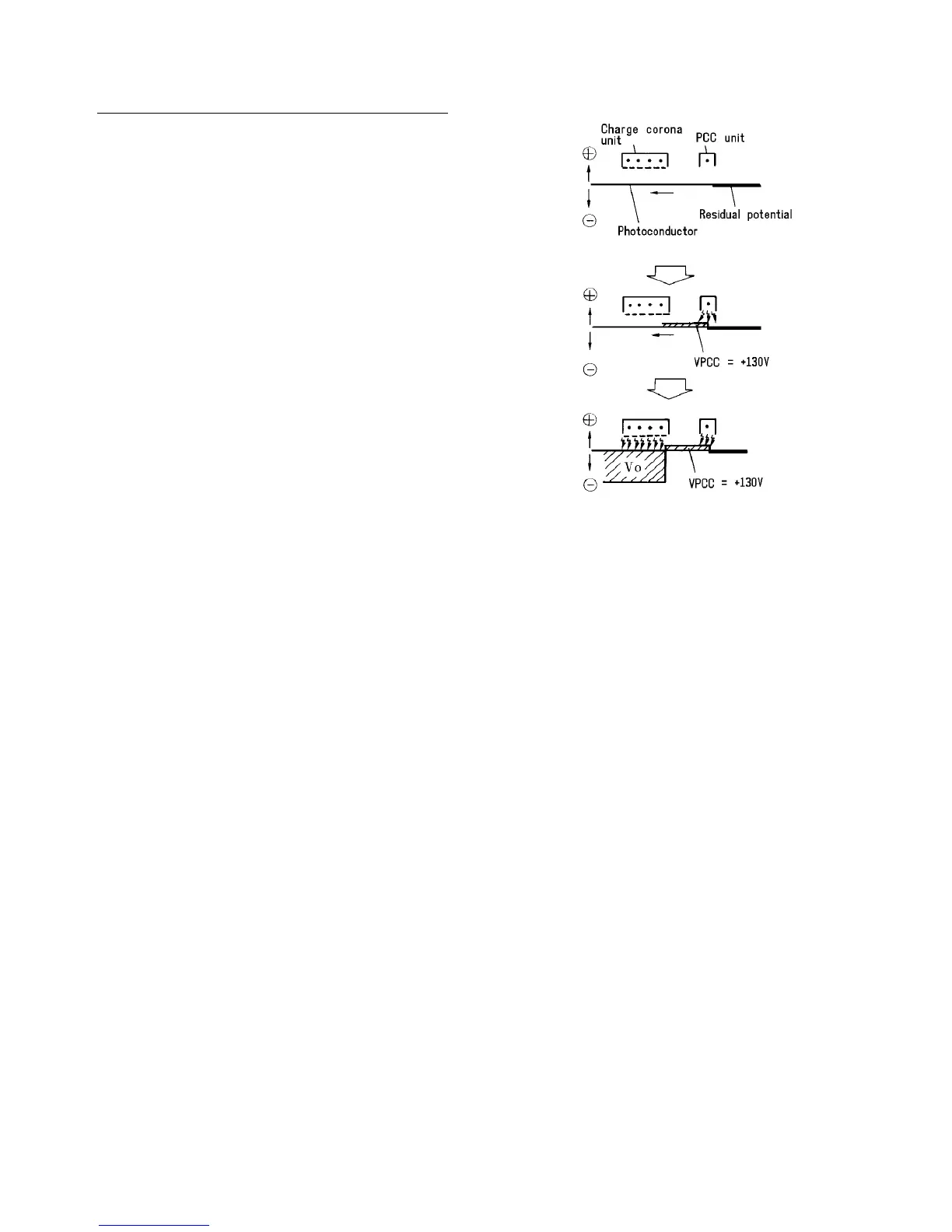
OPC stabilization before charging
VPCC compensation
If the surface potential before charging fluctuates, the
OPC cannot have a uniform and steady potential after
charging.
The surface potential before charging, called VPCC, is
kept constant by controlling the voltage applied to the
PCC (Pre-Cleaning Corona).
After every 500 copies during a continuous copy run,
VPCC is measured by the potential sensor (B sensor).
(If the OPC belt has turned only once for copying before
the measurement timing, the measurement is done the
next time the OPC belt does two or more rotations. This
is to stabilize VPCC.) After the OPC surface is
discharged by the PCC, charging and exposing are not
done and the potential sensor senses the OPC surface.
If the value is different from the predetermined target
value, the PCC output level is changed (20 volts per 1
step and 1 step maximum compensation at one time).
Normally, the target VPCC is set to +130 volts by
service tool [4-01] to obtain good cleaning performance.
NOTE
The PCC applies positive discharge to the OPC.
However, the OPC does not keep positive charges
well, So, VPCC data in the [4-01] screen tends to
fluctuate, but there is less effect on VPCC
compensation.



 To Next Page