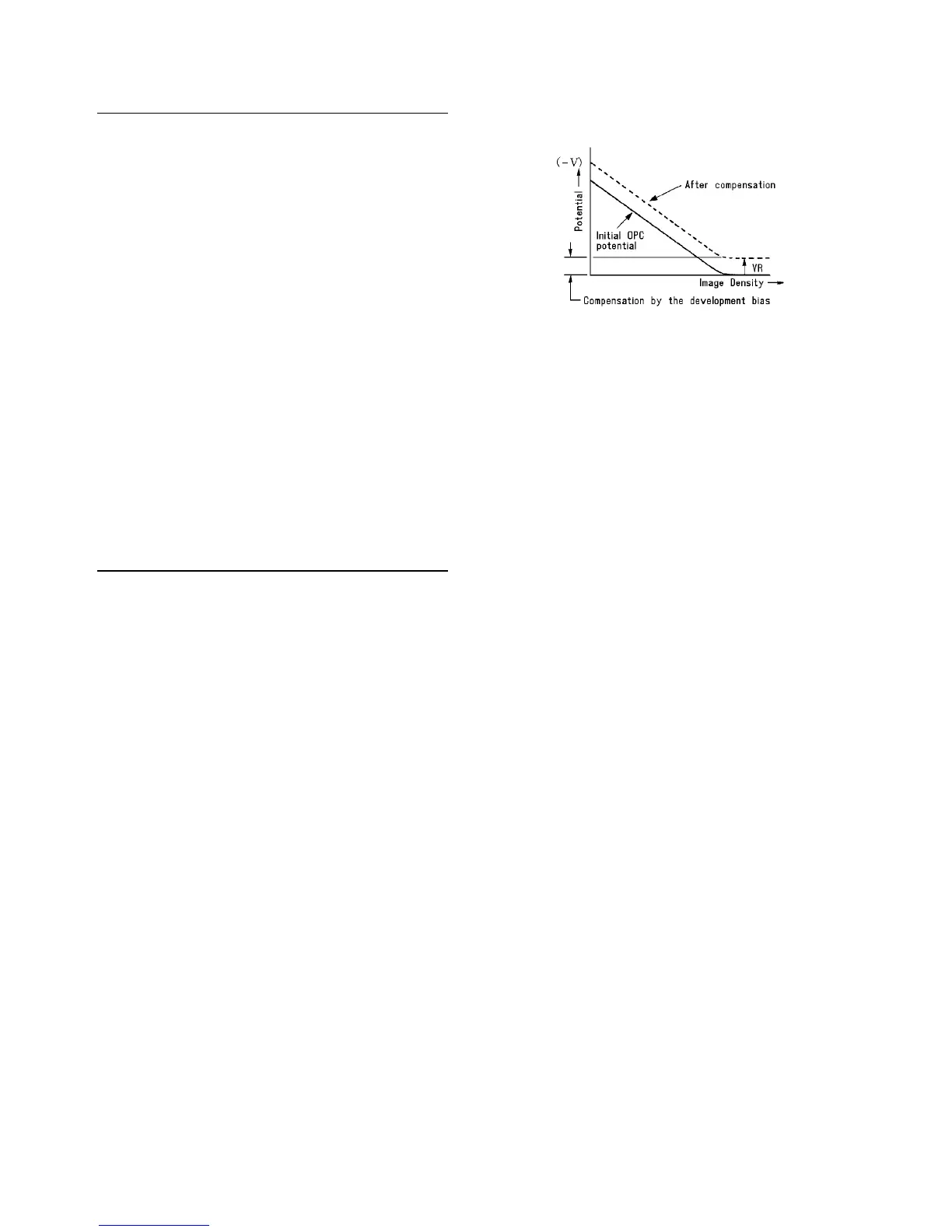
Compensation in image development process
VR compensation
After VD and VL compensations, the surface potential
curve shows almost the same slope as that of the initial
OPC potential. But as the amount of charge rises
equally, excessive image density occurs during image
development processing. The development bias is
shifted up to compensate for the raised amount of
charge and to obtain images similar to those at the initial
OPC potential.
The residual potential of the OPC (VR) is the potential
after removal of charge by the quenching lamp of the
OPC unit. For the measurement, the OPC surface is
charged by the transfer corona and the quenching lamp
clears it. Then, the potential sensor (B sensor) senses
the OPC surface. The measurement is done at power on
and after every 500 or more copies are finished.
If the potential sensor detects 22.5 volts or more of VR
at that time, the development bias output is changed.
One step shift of the bias output is 15 volts, and 3 steps
maximum shift at one time.
OPC rest time compensation
V0 compensation
The sensitivity of the OPC and the operating
environment (temperature and humidity) may change
according to the rest time of the machine. V0
compensation is done to determine the grid output for
the first 20 copies. After that, VD compensation
compensates the grid output.
The flash output shifted up two steps from the flash
output previous used (just before power was turned off)
is always used for the first 10 copies. After that, VL
compensation compensates the flash output.
At power on when the rest time of the machine is more
than one hour, V0 compensation is done. For the
measurement, the OPC surface is charged by the
charge corona. Then, the potential sensor (B sensor)
senses the OPC surface without exposing. This potential
is called V
0
. V0 is also measured in the same way at the
end of each copy run. The grid output is compensated
for to obtain the value of V
0
immediately before the
power was turned off.



 To Next Page