Reference Manual
00809-0100-4360, Rev BA
August 2008
Rosemount 1151
4-16
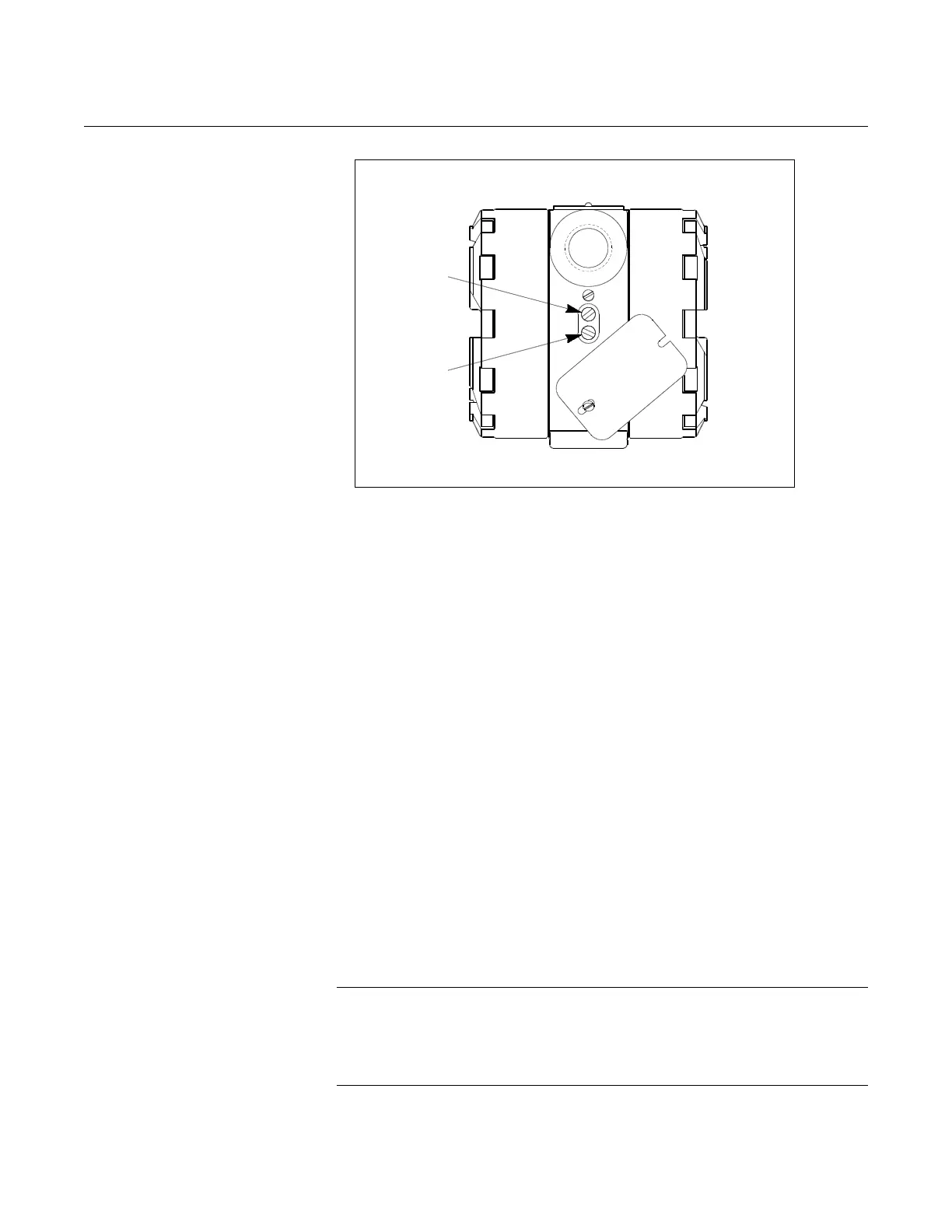
Figure 4-10. Zero and Span
Adjustment Screws.
Elevated or Suppressed
Zeros
Non-zero-based calibrations are termed as having “elevated” or “suppressed”
zeros. Calibrations that have a lower calibrated value below zero are termed
elevated. Compound ranges are included in this category. Calibrations that
have a lower calibrated value above zero are termed suppressed.
The easiest way to calibrate transmitters with elevated or suppressed zeros is
to perform a zero-based calibration and then elevate or suppress the zero by
adjusting the zero adjustment screw.
Rosemount 1151 Analog DP Range 4 Suppression Example: For a
desired calibration of 20 to 120 inH
2
O (4.9 to 29.8 kPa), proceed as follows:
1. Calibrate the transmitter to 0 to 100 inH
2
O (0 to 24.8 kPa) as described
in the zero and span adjustment information.
2. Apply 20 inH
2
O (4.9 kPa) to the high side process connection, and adjust
the zero until the transmitter output reads 4 mA.
Do not use the span adjustment.
Rosemount 1151 Analog DP Range 4 Elevation Example: For a calibration
of –120 to –20 inH
2
O (–29.8 to –4.9 kPa), proceed as follows:
1. Calibrate the transmitter to 0 to 100 inH
2
O (0 to 24.8 kPa) as described
in the zero and span adjustment information.
2. Apply 120 inH
2
O (29.8 kPa) to the low side process connection, and
adjust the zero until the transmitter output reads 4 mA.
Do not use the span adjustment.
NOTE
For large amounts of elevation or suppression, it may be necessary to
reposition the ELEVATE/SUPPRESS ZERO jumper. To do this, remove the
amplifier board, and move the jumper to the ELEVATE or SUPPRESS
position as required. See Figure 4-9 on page -15.





 To Next Page