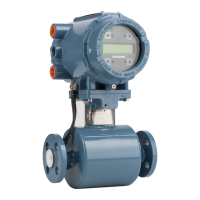
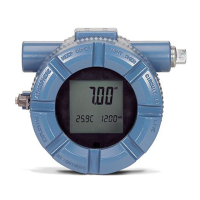
Rosemount Model 8732C Integral Mount Magnetic Flowmeter System
C-2
PROCEDURES
If the output of your Model 8732C is unstable, first check the wiring
and grounding associated with the magnetic flowmeter system (see the
Installation Check and Guide on page 2-23).Ensure that the
following conditions are met:
• Ground straps are attached to the adjacent flange or ground ring?
• Grounding rings, lining protectors, or grounding electrodes are
being used in lined or nonconductive piping?
• Both of the shields attached at both ends?
The causes of unstable transmitter output can usually be traced to
extraneous voltages on the measuring electrodes. This “process noise”
can arise from several causes including electrochemical reactions
between the fluid and the electrode, chemical reactions in the process
itself, free ion activity in the fluid, or some other disturbance of the
fluid/electrode capacitive layer. In such noisy applications, an analysis
of the frequency spectrum reveals process noise that typically becomes
significant below 15 Hz.
In some cases, the effects of process noise may be sharply reduced by
elevating the coil drive frequency above the 15 Hz region. The Model
8732C coil drive mode is selectable between the standard 6 Hz and the
noise-reducing 30 Hz. See Noise Reduction (Damping on page 4-12)
for instructions on how to change the coil drive mode to 30 Hz.
Auto Zero
To ensure optimum accuracy when using 30 Hz coil drive mode, there is
an auto zero function that must be initiated during start-up. The auto
zero operation is also discussed in the start-up and configuration
sections. When using 30 Hz coil drive mode it is important to zero the
system for the specific application and installation.
The auto zero procedure should be performed only under
the following conditions:
1. With the transmitter and flowtube installed in their final
positions. This procedure is not applicable on the bench.
2. With the transmitter in 30 Hz coil drive mode. Never attempt this
procedure with the transmitter in 6 Hz coil drive mode.
3. With the flowtube full of process fluid at zero flow.
These conditions should cause an output equivalent to zero flow.
Signal Processing
If the 30 Hz coil drive mode has been set, and the output is still
unstable, the damping and signal processing function should be used. It
is important to set the coil drive mode to 30 Hz first, so the loop
response time is not increased.
The Model 8732C provides for a very easy and straightforward start-up,
and also incorporates the capability to deal with difficult applications
that have previously manifested themselves in a noisy output signal. In
addition to selecting a higher coil drive frequency (30 Hz vs. 6 Hz) to
isolate the flow signal from the process noise, the Model 8732C
microprocessor can actually scrutinize each input based on three user-
defined parameters to reject the noise specific to the application.




 To Next Page