Appendix
D-1
D Magnetic Flow
Operating Principles
OPERATING PRINCIPLE
The operating principle of the magnetic flowtube is based on Faraday’s
law of electromagnetic induction, which states that a voltage will be
induced in a conductor moving through a magnetic field.
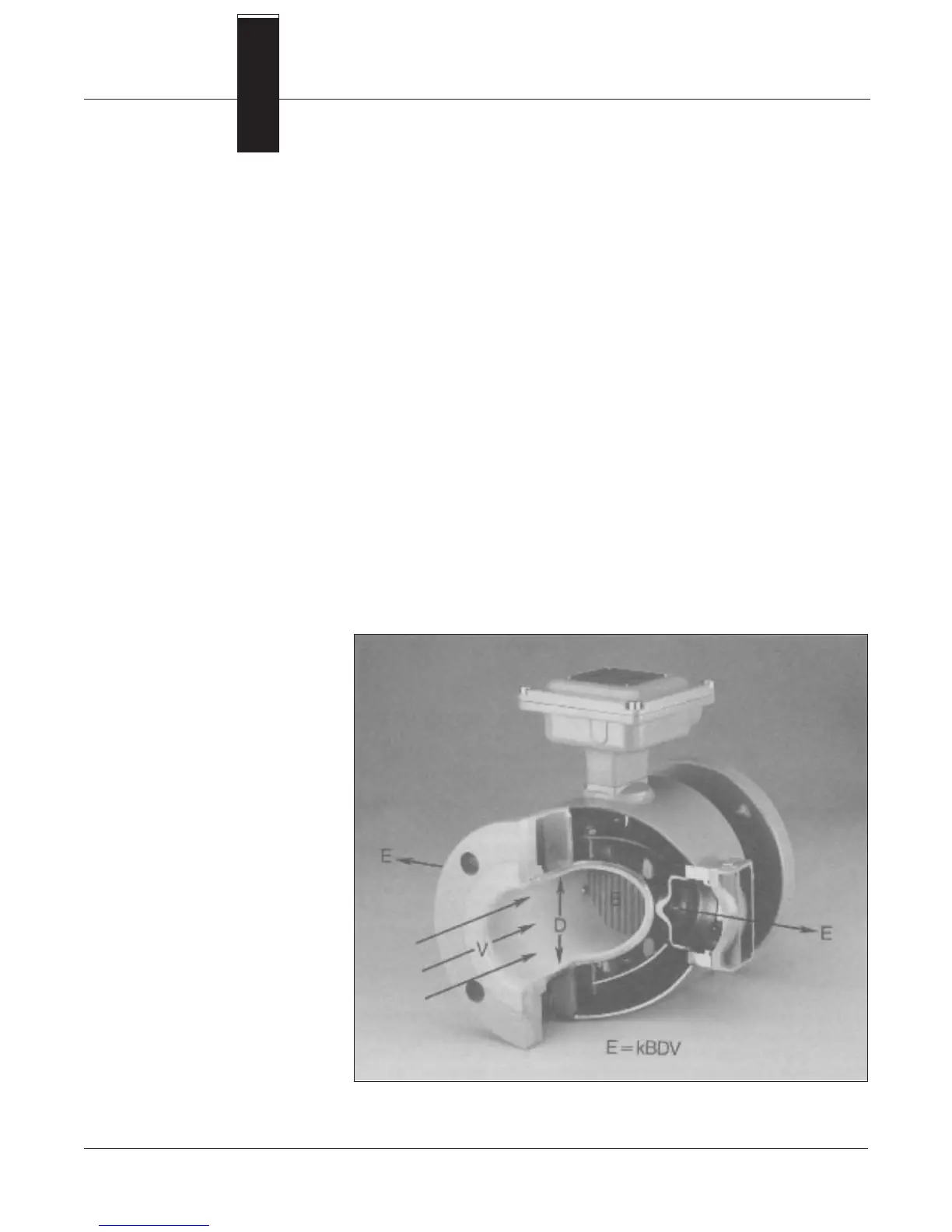
Faraday’s law: E = kBDV
The magnitude of the induced voltage E is directly proportional to the
velocity of the conductor V, conductor width D, and the strength of the
magnetic field B.
Figure D-1 illustrates the relationship between the physical
components of the magnetic flowmeter and Faraday’s law. Field coils
placed on opposite sides of the pipe generate a magnetic field. As the
conductive process liquid moves through the field with average velocity
V, electrodes sense the induced voltage. The width of the conductor is
represented by the distance between electrodes. An insulating liner
prevents the signal from shorting to the pipe wall. The only variable in
this application of Faraday’s law is the velocity of the conductive liquid
V, because field strength is a controlled constant and electrode spacing
is fixed. Therefore, the output voltage E is directly proportional to
liquid velocity, resulting in the inherently linear output of the
Rosemount Magnetic Flowmeter System.
FIGURE D-1. Flowtube Cross Section.











 To Next Page