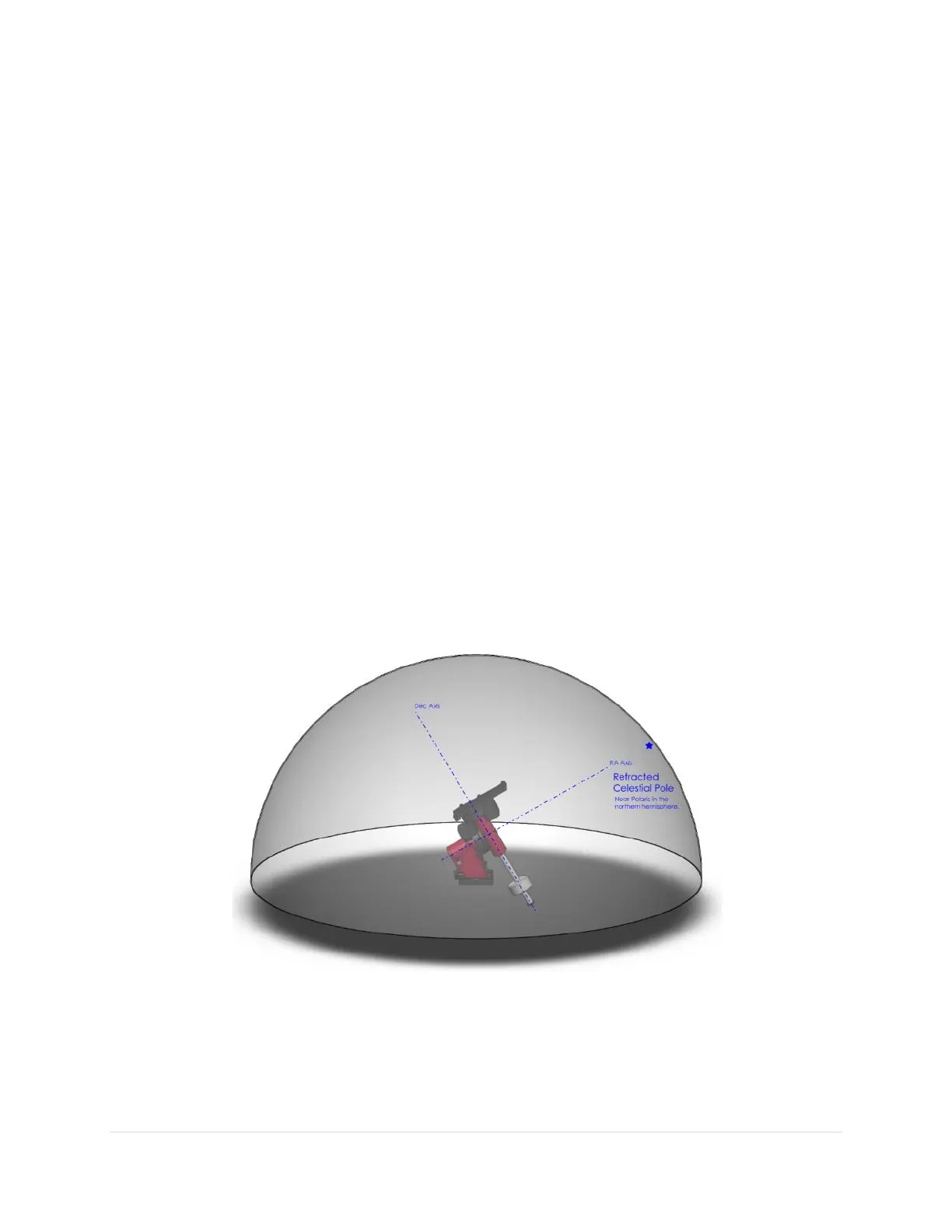
of the polar alignment error. (There are several other mount geometry errors that
affect pointing and tracking performance.)
For example, if the mount’s polar axis is ten degrees below the celestial pole in
altitude, then the resulting calibration positions computed by TheSky Professional
will be wrong by at least this same amount in declination. The result is that the
mount will not point or track stars accurately.
After collecting a minimum of six calibration points, a basic TPoint model
comprised of the six fundamental geometric errors is generated and the pointing
accuracy is greatly improved on subsequent slews. As more calibration points are
collected, the TPoint model better characterizes the repeatable errors in the
telescope. After about 50–100 calibration points, TPoint can create a model that
produces exceptional pointing and tracking.
• With fewer than six calibration points, the mount’s pointing accuracy will be
disappointing, especially when the telescope changes sides of the pier.
These may make you frustrated with the performance of your Paramount and leave you
wondering, “What am I doing wrong?” Mastering polar alignment techniques described
below (or using your preferred polar alignment technique) and pointing calibration is
crucial to achieve optimal mount performance.



 To Next Page