Paramount GEM User Guide
69 | P a g e
The Paramount ME, Paramount MX, Paramount MX and Paramount MYT PSUs use tip positive plugs. See
“Power Supply Unit" on page 100 for more information.
Plugging Power Supply Unit into the Electronics Box
The table below describes how to physically connect the PSU of each model from the external power
source to the 48V Power In port (page 68) on the Electronics Box. The Paramount MX PSU can be plugged
directly into the 48V Power In port on the Electronics Box; the Paramount ME requires an additional power
extension cable.
Connecting PSU to 48V Power In Port
Connecting the PSU
to External Power
Plug the male Kobiconn DC power plug on the Power Supply
Extension Cable into the port labeled 48V Power on the
Electronics Box.
Plug the female end of
the Power Cable for
the Power Supply Unit
(page 42) into the
PSU’s power input.
Plug the male end into
an external power
supply.
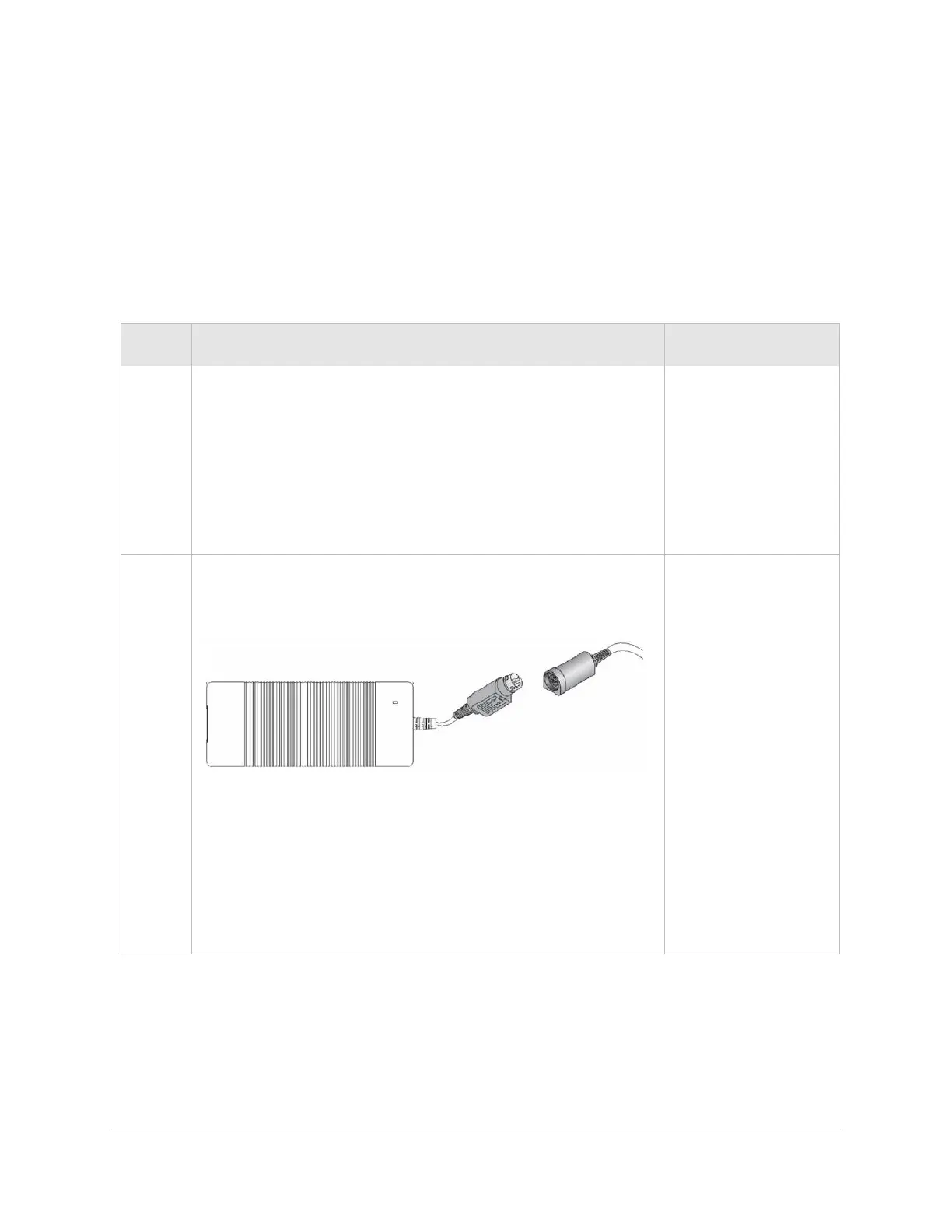
1. Plug the 4-pin locking male Kycon connector on the PSU
into the female Kycon connector on the Power Supply
Extension Cable.
Figure 30: Paramount ME PSU plugs into the Power Supply Extension Cable.
Do not attempt to plug the 4-pin Kycon connector on the PSU
into the Electronics Box port labeled Power In.
2. Plug the male Kobiconn DC power plug on the Power Supply
Extension Cable into the port labeled 48 V Power on the
Electronics Box.
Plug the female end of
the Power Cable for
the Power Supply Unit
(page 42) into the
PSU’s power input.
Plug the male end into
an external power
supply (electrical grid,
battery, or suitable
other power source).
Polar Axis Adjustments
A common problem with many commercial mounts when making polar alignment adjustments is that
changes to the position of the altitude axis also changes the position of the azimuth axis, and vice-versa.
In other words, the basic mechanical design is flawed in that it prevents independent motion in azimuth
and altitude. This makes polar alignment more difficult than it should be.



 To Next Page