3-12 ENGINE CONTROL SYSTEM
12 V
(Voltage)
Terminal voltage
Spark timing
(Time)
Battery
charge
coil
Rectifier &
regulator
Battry
ECM
CPU
Ignition coil
Spark plug
Sensor/switch
signal input
ECM
main
relay
Ignition
switch
30 A fuse
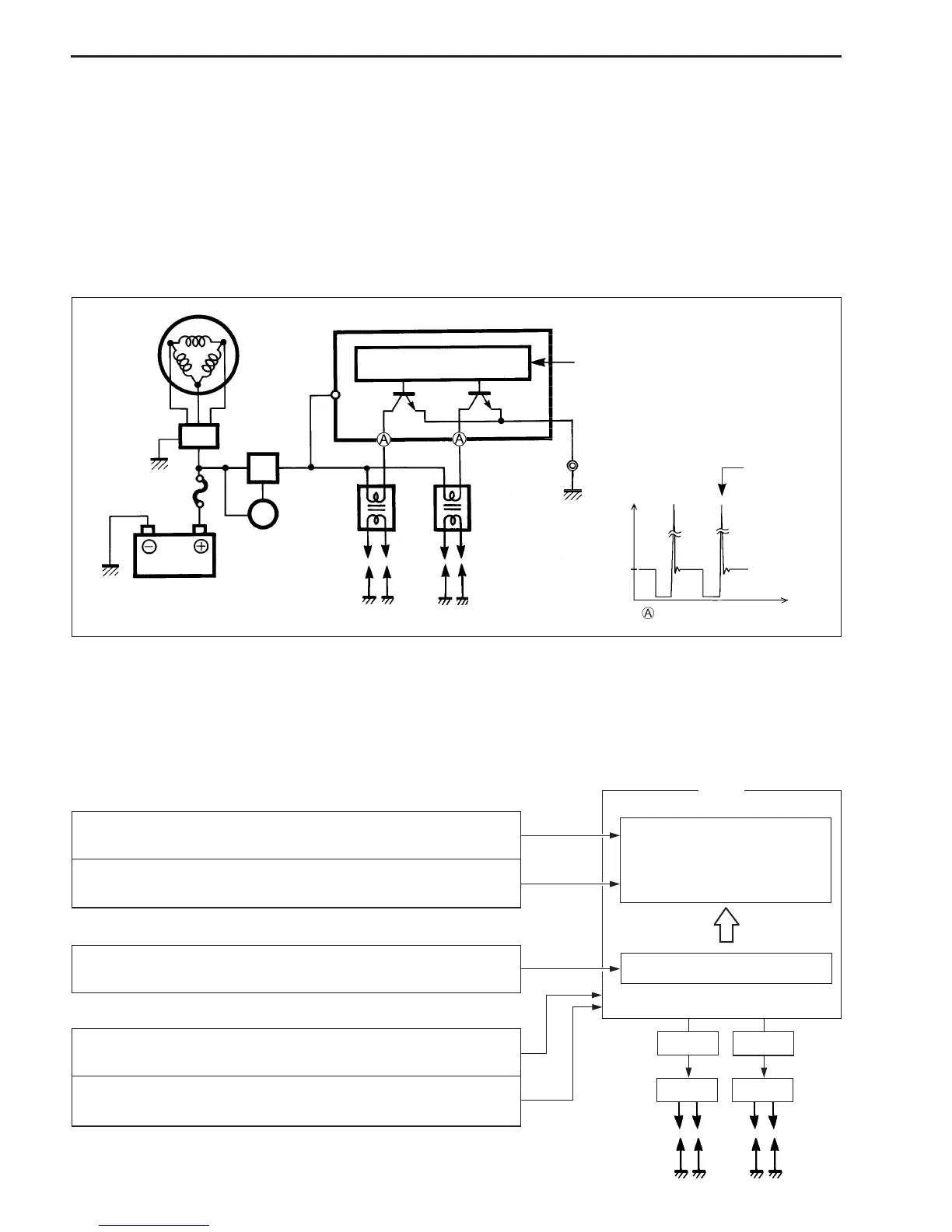
IGNITION CONTROL SYSTEM
OUTLINE
The sensors at specific points on the engine monitor current engine conditions and send signals to the ECM.
Based on these signals, the ECM determines the optimum ignition timing and releases voltage to the ignition
coils.
IGNITION SYSTEM
The ignition system used by the DF60/DF70 is a fully transistorized, electronic microcomputer timing ad-
vanced type.
This system is totally battery powered, with the ECM controlling all ignition timing functions.
The ignition system is composed of the ignition coil, spark plug and components for system control (ECM,
sensor, switch, etc.).
When the ignition switch is “ON”, battery voltage (12V) is applied to the circuit as shown in the illustration.
At the calculated time of ignition, the transistor in the ECM turns “OFF”, breaking the grounded circuit. In this
way, a mutual induction high voltage occurs in the ignition coil secondary side and spark is generated.
Basic sensors
Compensating sensor
Others
Spark plug
MAP sensor:
Informs ECM of intake manifold pressure.
CKP sensor:
Informs ECM of engine speed and crankshaft angle.
Cylinder temperature sensor:
Informs ECM of cylinder temperature.
CTP switch:
Informs ECM of throttle position (open / closed).
Ignition switch:
Informs ECM of “START” signal.
Ignition timing is determined by
a digital map designed in rela-
tion to intake manifold pressure
and engine speed.
ECM
Signal
Ign.coil
Signal
Ign.coil
Ignition timing compensation



 To Next Page