IM-LYOQUEST-EN-2101 13 / 58
8. WORKING PRINCIPLE
8.1. Freeze
The product inserted into the equipment can either be previously frozen or can be frozen in
the ice condenser. To freeze it in the condenser, the product is placed into the plate stack
(optional accessory), and the condenser is cooled selecting the option "freezing" on the touch
screen, both in semiautomatic mode and in automatic mode.
The freeze temperature is proportional to the solidification point of product. Freezing speed
influences the size of the crystals and, consequently, sublimation speed. Therefore, the most
suitable freeze parameters for each product must be determined. It is advisable to freeze
products at a temperature below -20°C for a period of 3-4 hours.
8.2. Lyophilization
8.2.1. In manifold
It is used to lyophilize bulk products in glass flasks with a grinding mouth (29/32mm Ø). The
products contained in the flasks (filling a quarter up to maximum half the flask) have to be
previously congealed in a rotating bath of alcohol, freezing the product to the walls of the
flask.
When the condenser has reached the programmed temperature, the following steps must be
performed:
1. Connect the vacuum unit.
2. Connect the flasks or bottles (with previously frozen product) to the valves connected
to the condenser.
3. Open the valves.
Then the vacuum is done inside flasks, and the sublimation of the product starts. A pressure
of less than 10mbar is reached within 10 minutes. If this does not happen, the pump will
stop, and the alarm of the vacuum system will appear. In this case the valve-flask
connections must be reviewed in order to assure that there is no leak.
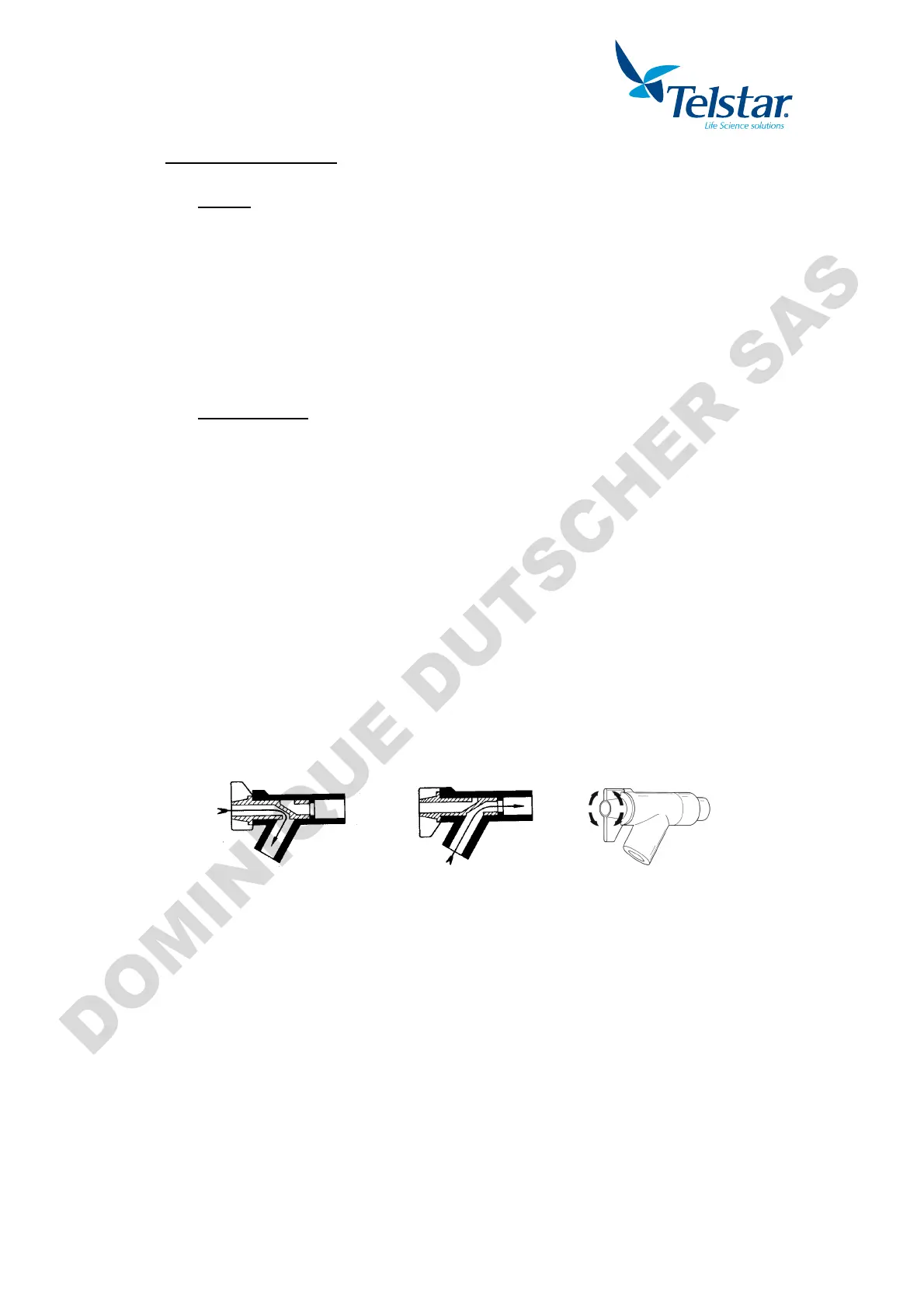
CONNECTION VALVE
Air inlet Start vacuum process
If it is necessary to connect additional flasks when the freeze-drying process has already
begun, the following steps must be performed:
1. Close all valves.
2. Connect the new flask and open its corresponding valve.
3. Wait 10-15 seconds in order for the pressure to be restored in the unit.
4. Open the valves of the other flasks.
It is possible to provide external heat by means of an electric heat source, in order to speed
up the drying process. The heat source should be at the suitable distance to apply the
radiation heat that the product requires. A hot air heater directed directly to the flasks may
also be used.
At the beginning of the process a layer of ice will form on the outside wall of the flask; this
will gradually disappear as drying out continues. When the exterior of the flask is at ambient
temperature, no ice remains in the product (the process has finished). Once the process has
finished, the corresponding valves of the manifold are closed, and air enters in the flasks. So,
they can be removed.


 To Next Page