Surveying with the Receiver
P/N 7010-0681
3-17
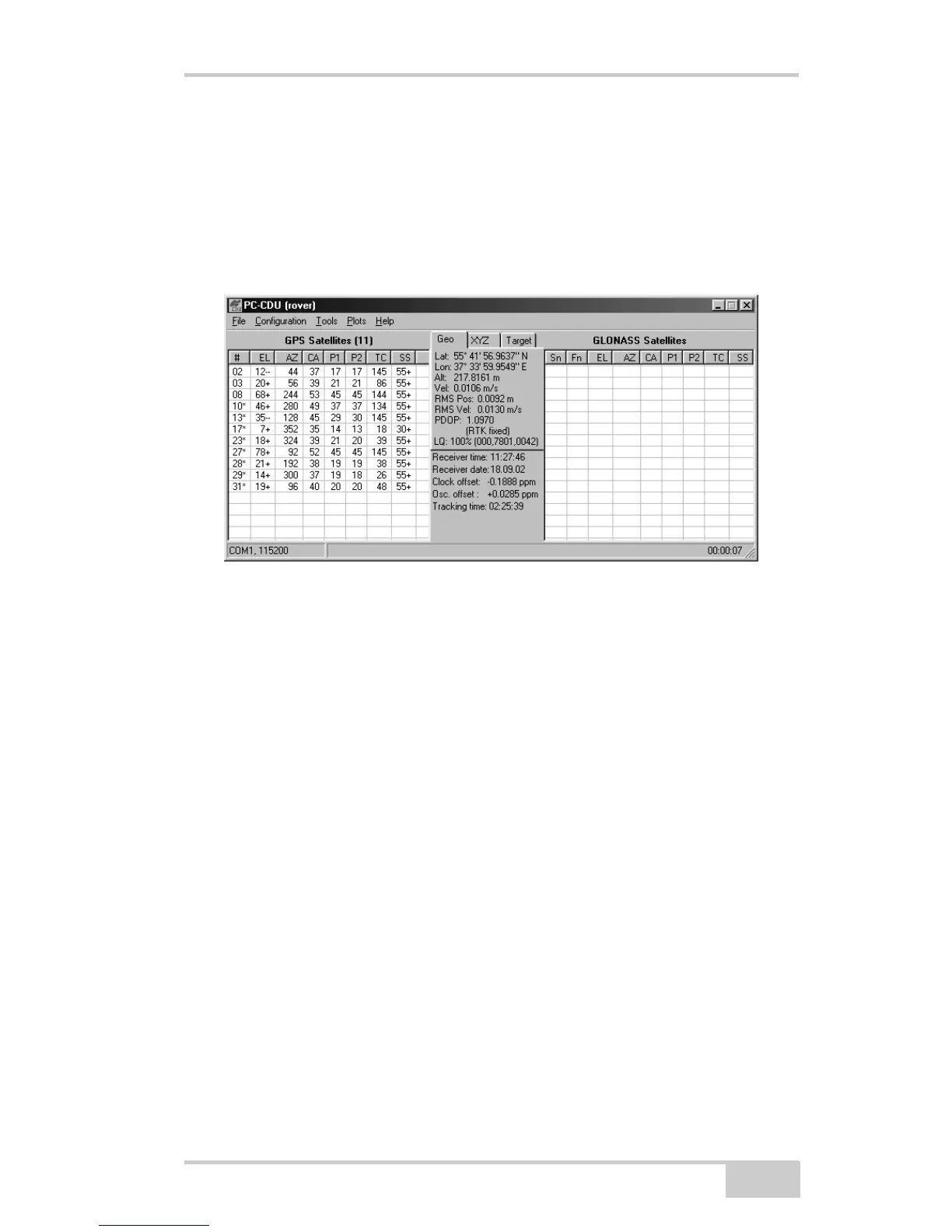
9. On the main screen (Figure 3-13), check the LQ field to ensure
the receiver obtains differential corrections. Usually, the receiver
will start to output the coordinates of the antenna’s phase center
along with the solution type within 10–30 seconds. However,
spread spectrum radios may take as long as 60 seconds to
synchronize.
Figure 3-13. PC-CDU Main Screen
The geodetic coordinates displayed on the Geo tab are always
computed in WGS84 and have four solution types.
• Standalone – where receiver computes 3D coordinates in
autonomous mode without using differential corrections.
• Code differential – where the Rover receiver computes the current
relative coordinate in differential mode using only pseudo ranges.
• RTK float – where the Rover receiver computes the current
relative coordinates in differential mode using both pseudo ranges
and phases; however, with a float solution, the phase ambiguity is
not a fixed integer number and the “float” estimate is used
instead.
• RTK fixed – where the Rover receiver computes current relative
coordinates, with ambiguity fixing, in differential mode.
The LQ field reflects the status of the received differential messages
and contains the following information:
• Data link quality in percentage
• Time (in seconds) elapsed since the last received message


 To Next Page