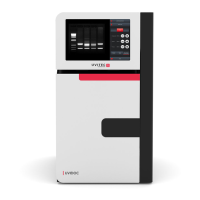
Need help?
Do you have a question about the UVITEC Cambridge FIREREADER MAX and is the answer not in the manual?
Lists registered trademarks for operating systems, processors, and software.
Legal agreement governing the use of the FireReader-FireReader 1D software.
Specifies the hardware requirements for running the FireReader system.
Instructions for opening the box and verifying system contents.
Steps for physically setting up the FireReader hardware components.
Essential conditions and warnings before starting software installation.
Initial steps and requirements for installing the Capt Advance software.
Warning about the "found new hardware wizard" during installation.
Detailed steps for installing the FireReader 1D software from the CD.
Safety precautions and warnings related to UV illumination and darkroom use.
Description of the main switch and connections on the darkroom unit.
A brief guide to performing the initial image acquisition process.
How to access the Exposure section of the software interface.
Feature to automatically calculate an ideal exposure time for image acquisition.
Allows users to manually set the exposure time for image acquisition.
Enables repetitive image acquisition for creating a series of images.
Adjusting lens settings like aperture, zoom, and focus for image clarity.
Module for calculating molecular weights of DNA/protein bands based on standards.
Module for counting and characterizing bacterial colonies in images.
Module for measuring distances between detected bands or spots.
Module for quantifying band volume and concentration.
Function to add text annotations and arrows to images.
Allows users to cut out a specific portion of an image.
Function to rotate or mirror images for better viewing or analysis.
Applies color palettes to monochrome images for enhanced visualization.
Sets band parameters for white/black backgrounds and vice-versa.
Combines a blot image with its marker image into a composite image.
Copies a marker from one image to a signal image.
Combines multiple fluorescent channels into a single composite image.
Combines colored and monochrome images for bioluminescence visualization.
Subtracts one image from another, e.g., to remove noise.
Removes background clutter from images for better analysis.
Corrects uneven illumination intensity across the image.
Removes dust or small defects from images.
Opens image files in various specified formats.
Saves images to new files or updates existing ones.
Prints previously opened images as they appear.
Adjusts system settings like filter controls and lens calibration.
Provides information on image quality and dynamic range.
Enhances image display by modifying greyscale selection.
Compares two or more images in a single view.
Tracks image treatments performed with the software.
Copies image, table, or graph to the clipboard.
Resizes the image to fit the monitor display area.
Allows users to zoom in or out of the image.
Defines pre-defined image acquisition parameters for specific applications.
How to access and select application protocols within the software.
Details the components and folders within an Application protocol.
Maintenance for the camera chamber, including temperature limits.
Cleaning instructions for the working tray using solvents or water.
Maintenance of air admission grids, advising against obstruction and dust.
Details power supply requirements, fuses, voltage, and frequency.
Specifies operating altitude, humidity, and temperature limits.
Advice on cleaning filters and keeping them dry.
Lists available spare parts for the FireReader D56 series with reference codes.
General advice on warranty terms, exclusions, and user responsibilities.
 General
| Brand | UVITEC Cambridge |
|---|---|
| Model | FIREREADER MAX |
| Category | Laboratory Equipment |
| Language | English |

 To Next Page