Maintenance and care of the instrument
VF1807090083 EN revision 68
8.8. Photomultiplier (PMT) life
The PMT is an electrical component that is able to detect very weak light signals, usually in a range of (295 -
630) nm.
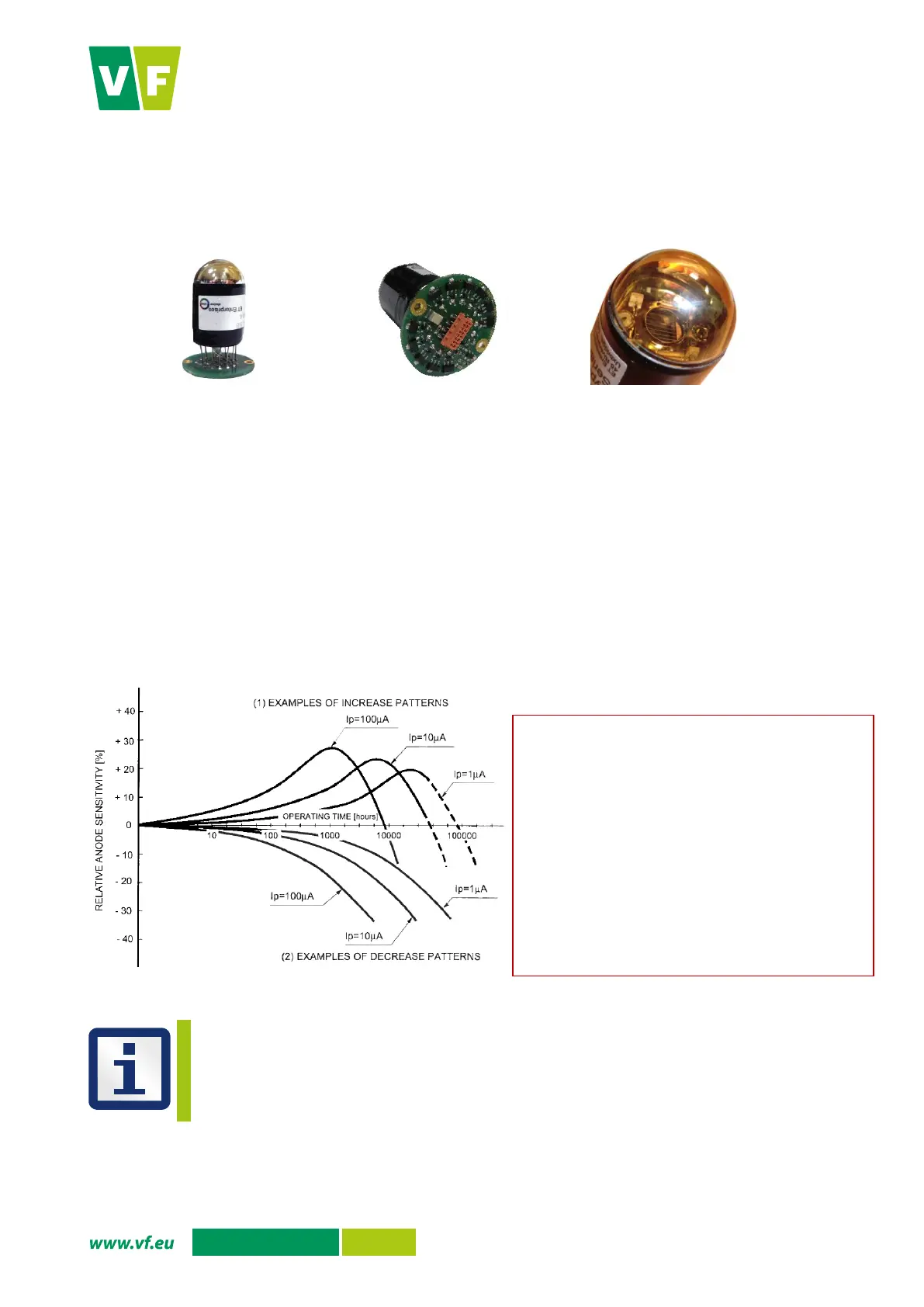
Fig. 55 Photomultiplier
When a photon impacts on a sensitive photocathode, the photoelectric effect results in the emission of
electrons, which are gradually accelerated by the electric voltage between the individual electrodes (dynodes).
The impact of accelerated electrons on the dynodes gives rise to the emission of a larger quantity of electrons
(secondary emission), resulting in an amplification of the electron current colliding with the anode.
PMT stability over time depends both on the anode current and on the material of the photo-cathode and
dynodes. The time dependence is a routine matter, i.e. the photomultipliers should be sorted for selected
applications. Each PMT is in VF tested and assessed as to whether or not its parameters meet the expected
requirements. The PMT testing and stabilization take usually 48 hours. The chart shows the typical dependence
of anode current over time. The detectors manufactured by our company have an anode current < 1
microampere, i.e. very long time stability. When the photomultiplier is not used for several months, its
properties can return into the state before stabilization.
Fig. 56 Typical dependence of the anode current of the photomultiplier over time
The photomultiplier is a very sensitive device
composed of a large amount of small
components, which are connected together by
soldering. If the PMT is exposed to shocks, it can
cause failure to the integrity of mechanical parts,
thus changing the parameters of the
photomultiplier. Mechanical failures of the PMT
are usually indicated by sparkling, i.e. an
increase in the count rate, which becomes
evident on the surrounding background after
turning on the instrument. An opposite effect,
i.e.a decrease in PMT response, can occur as a
result of loss of vacuum.


 To Next Page