3. Troubleshooting
120
3.4 Troubleshooting by
measuring compression
pressure
Compression pressure drop is one of major causes
of increasing blowby gas (lubricating oil contamina-
tion or increased lubricating oil consumption as a
resultant phenomenon) or starting failure. The com-
pression pressure is affected by the following factors:
1) Degree of clearance between piston and
cylinder.
2) Degree of clearance at intake/exhaust valve
seat.
3) Gas leak from nozzle gasket or cylinder head
gasket.
In other words, the pressure drops due to
increased parts wear and reduced durability
resulting from long use of the engine.
A pressure drop may also be caused by scratched
cylinder or piston by dust entrance from the dirty
air cleaner element or worn or broken piston ring.
Measure the compression pressure to diagnose
presence of any abnormality in the engine.
(1) Compression pressure measurement
method
1) After warming up the engine, remove the fuel
injection pipe and valves from the cylinder to
be measured.
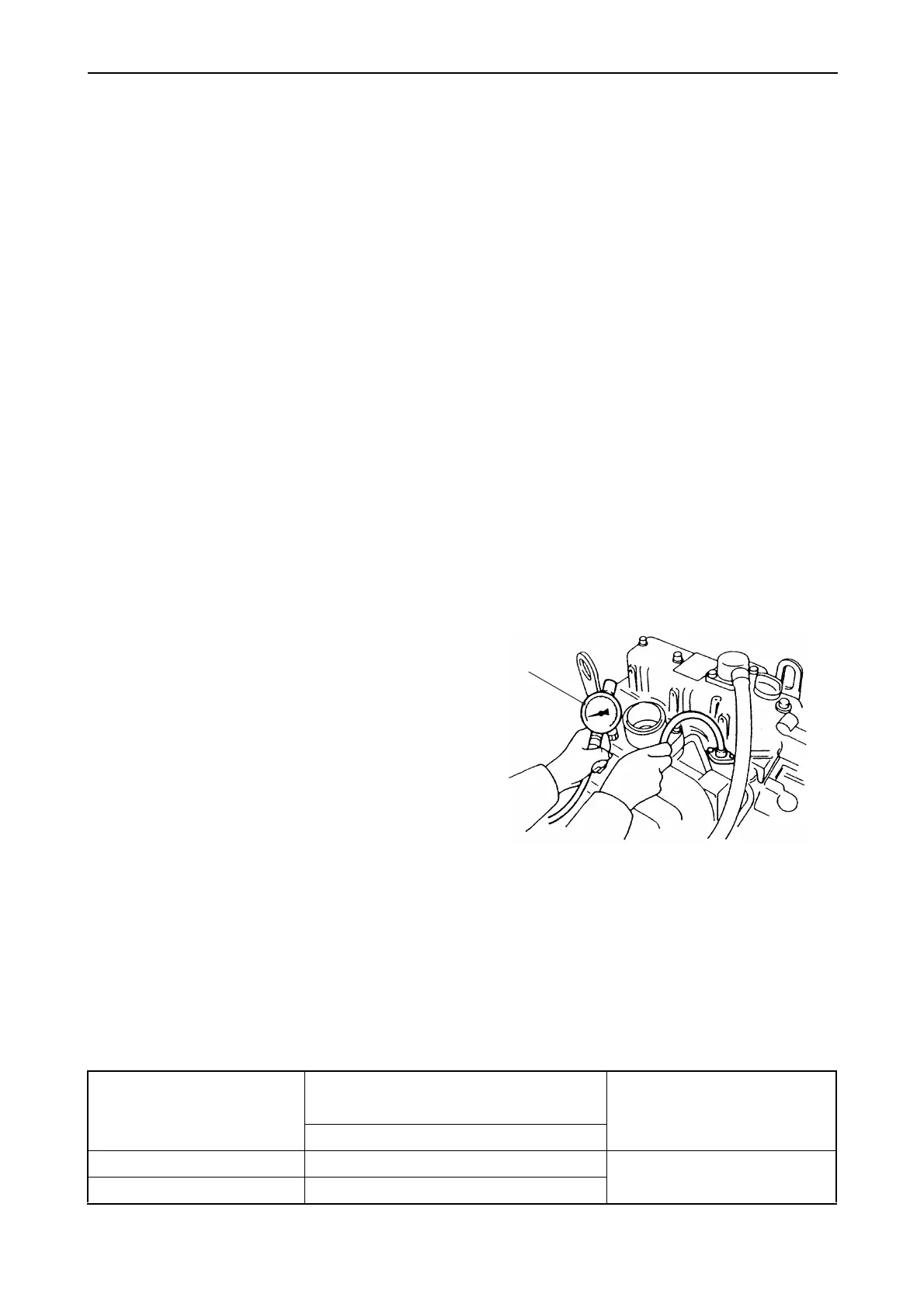
2) Crank the engine before installing the
compression gage adapter.
a) Perform cranking with the stop handle at the
stop position (no injection state).
b) See 4.2.3(2) in Chapter 4 for the
compression gage and compression gage
adapter.
3) Install the compression gage and
compression gage adapter at the cylinder to
be measured.
a) Never forget to install a gasket at the tip end
of the adapter.
4) With the engine set to the same state as in
2)a), crank the engine by the starter motor
until the compression gage reading is
stabilized.
(2) Standard compression pressure
Engine compression pressure list (reference value)
Model
Compression pressure at 250 min
-1
MPa (kgf/cm
2
)
Deviation among cylinders
MPa (kgf/cm
2
)
Standard
3JH4E/ 4JH4E/ 4JH4-TE 3.4
±
0.1 (35
±
1)
0.2 to 0.3 (2 to 3)
4JH4-HTE 3.2
±
0.1 (32
±
1)
Compression
gage
010638-00SE



 To Next Page