Safety measures S88 / OPMI Lumera T
Version 8.0
Page 20 G-30-1682-en
Angle of illumination
Several publications
1)-4)
suggest tilting the microscope to reduce the exposure
of the macula to direct illumination.
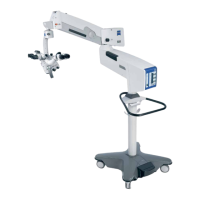
The surgical microscope features a tilting mechanism for the main microscope
to enable indirect illumination.
Focus of the light source
Studies show that injuries are likely to occur if the filament of the light source
is imaged on the patient's retina. The peak intensity of a filament is considerably
higher than that of an even and extended light source such as a light guide.
For this reason, ZEISS uses fiber optic illumination in its surgical microscope
systems.
Exposure time to light
According to some publications, the phakic and aphakic eye should not be
exposed to the light source longer than a few minutes. In all surgical cases,
the retinal exposure time to light depends on the type and duration of the
procedure and possible case complications. It is therefore recommended in
ophthalmic surgery to keep the light intensity as low as possible, or to use
a device which prevents the light from entering the patient's pupil. It is also
recommended to make sure that the patient's eye is not additionally exposed
to the light of surrounding light sources. This problem has been solved by
ZEISS by the use of a retinal protection device that can be swung into the
microscope's illumination beam path and a blue barrier filter (retina
protection filter).
Brightness setting
The brightness control scale of our systems has a linear structure with values
ranging from 0.5 through 10. The stipulations of ISO Standard 15004-2:2007
result in maximum radiation exposure times for the different illumination
configurations as specified in the table "Maximum radiation exposure times".
The microscope light source – like any bright light source – may present
a hazard to the patient’s eye both in the form of immediately visible thermal
damage to the retina as well as phototoxic chemical reactions which may lead
to photoretinitis. The factors which play an important role in determining the
phototoxic risk are:
– Lamp brightness.




 To Next Page