Section 9
Principles of Procedure and Operation 9-1
Principles of Procedure
and Operation
9.1 Principles of Procedure
The operator introduces a heparinized whole blood sample (or heparin-
ized plasma, serum, or control) into the reagent rotor. The reagent rotor
contains a diluent, and test-specific reagent beads. The operator then
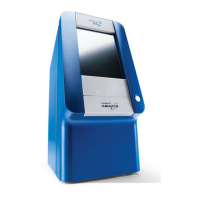
places the rotor in the VetScan VS2 Chemistry Analyzer and enters the
appropriate identification numbers. The VS2 Analyzer automatically
performs the remainder of the testing protocol.
The reagent rotor spins and whole blood is separated into plasma and
blood cells. During this time, the rotor is heated to 37 ºC (98.6 ºF). Pre-
cisely measured quantities of plasma and diluent enter the mixing cham-
ber and are combined. Centrifugal and capillary forces distribute the
diluted plasma to cuvettes on the perimeter of the rotor. Reagent beads in
the cuvettes are dissolved by the diluted plasma. This solution is thor-
oughly mixed, and the resulting chemical reactions are monitored photo-
metrically by the analyzer. Optical signals generated by the chemical
reactions are used to calculate analyte concentrations. Calibration data
specific for the chemistries in each rotor are provided to the analyzer by
the bar code printed on the bar code ring.
After analysis is complete, the results print automatically, and include
analyte concentrations and reference ranges for each test in the panel, as
well as sample indices. Results are also stored in the analyzer’s memory
and can be transmitted to external computers. The used reagent rotor is
removed and discarded. The VS2 is ready to analyze another sample.


 To Next Page