4-14 Test Procedure and Results
■ The symbols “~~~” are printed in place of numbers when a result cannot be deter-
mined — that is, when the result is suppressed. A result can be suppressed due to
improper mixing of a reagent bead with diluted sample, a nonlinear reaction, an
endpoint of a particular reaction not reached, or a concentration outside the ana-
lyzer’s capabilities. When a chemistry is suppressed (~~~), the analyzer prints an
error report by default.
■ HEM, LIP, or ICT is printed in place of the analyte concentration if hemolysis,
lipemia, or icterus has adversely affected the results. LIP is also printed if both
lipemia and icterus have been affected. HEM is also printed if hemolysis and ict-
erus, hemolysis and lipemia, or hemolysis, lipemia, and icterus have affected a par-
ticular analyte. Examine the sample indices to determine if more than one
interferent is affecting a particular result.
■ The sample indices are included at the bottom of the results. These indicate the
degree of hemolysis, icterus, and lipemia found in the sample, measured on a scale
of 0 (clear), 1+ (slight), 2+ (moderate), and 3+ (gross).
If the sample is identified as hemolytic, collect a new sample and run another reagent rotor. If the
new sample is also hemolytic, refer to Section 8. High lipemia may be due to diet. Ensure the
patient has fasted for at least 12 hours before collecting another sample. For suggestions on test-
ing grossly lipemic or icteric samples, see Section 8.
4.7 Test Procedure Summary
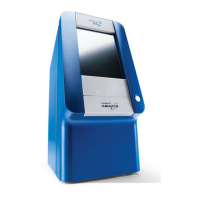
VetScan VS2 Chemistry Analyzer
■ Check that the electrical outlet utilized for the analyzer is grounded.
■ Check that the ambient temperature where the analyzer is located is 15–32 ºC
(59–90 ºF).
■ Do not disconnect the power to the analyzer while running a sample.
■ Keep the analyzer drawer closed when not in use.
■ Do not attempt to repair the analyzer; this may void the warranty. Refer to
Section 8 for troubleshooting and Section 10 for regular maintenance.


 To Next Page